

Naaman went down and immersed himself seven times in the Jordan, according to the word of the man of God;
his flesh was restored like the flesh of a young boy, and he was clean.
2 Kings 5:14
Dearly Beloved,
By every measure he came out on top. He was a leader esteemed by his peers and revered by those who served under him. A warrior whose acumen on the battlefield provoked fear in his enemies; a commander of distinction whose unswerving loyalty had earned him the trust of his king. But in spite of all the accolades, there was one weakness he could not hide: Naaman was afflicted with leprosy. And this undeniable fact—this highly visible disease over which he had no control—threatened to define his life.
Leprosy and other skin maladies, in ancient as well as modern times, have long stuck fear in the hearts of those who’ve contracted them, and their families. A colleague of mine, who once served a parish on the Hawaiian island of Molokai, spoke of the history of the community of Kalaupapa, which for a century served as a colony for people with leprosy—or Hansen’s disease as we now call it. Despite the advent of new and effective treatments, he said social prejudices continued to prevail. During his tenure at Kalaupapa, church groups who came to the island to work on service projects invariably left something behind when they departed. In the dorm where they had stayed he’d invariably find a garbage sack. Its contents? All the clothing they’d used while they were on the island.
It takes a great deal of effort—internal commitment combined with outward practice—to move beyond the baked-in assumptions and prejudices that are run through our veins and run through our world today and, to a greater or lesser degree, always have. But that journey can begin with a simple step. That’s the premise of the POTLUCK PROJECT, the brainchild of Paths to Understanding, an organization led by Pastor Terry Kyllo committed to bridging bias and building community through multifaith peace keeping. The Potluck Project builds upon a model of community-making that Jesus himself used throughout his ministry: gathering with diverse people for a shared meal. It was at these meals that Jesus taught about the Kin-dom of God. It was at these meals that he challenged religious leaders not to allow MERCY to be trumped by concerns about PURITY. It was at these meals that he coached his apprentices with stories, preparing them to carry on with his mission after he was gone. His words, “DO THIS TO REMEMBER ME,” apply not only to the institution of the Lord’s Supper—they apply to the modus operandi Jesus used to engage the world.
Over the past year I’ve been cultivating the opportunity for our congregation to join the Potluck Project. Now, at last, the first concrete steps are in place and I invite you to be part of them. Rabbi Allison Flash of the Kol HaNeshamah Synagogue and I are committed to bringing our communities together using the model developed by Paths to Understanding, and we now have TWO DATES ON THE CALENDAR: Sunday, Sept. 14, 5:30-7:30, and Sunday, Feb. 1st, 5:30-7:30pm. Please mark your calendars and plan to be part of this important movement! These planned events are the beginning of what we hope will be an expanding opportunity to bring diverse neighbors together—including folks of other faith traditions or none. I am looking for people to join a planning team for these events, which we hope to extend beyond the first two initial gatherings. If you are open to being part of such a team, please let me know.
Last week Marcia Olson and I paid a visit to Fatima Adam, a staff member of Hope Academy, a charter school serving Muslim children that is housed on the property formerly belonging to St. James Lutheran in White Center. Fatima, along with her sister Asia, who I met with earlier this year, have been eager to learn about the history of St. James church and its commitment to serving the larger White Center community. It was great to have Marcia along to share some of that history. At the end of our time together, Fatima said something that has stuck with me: “There is a story God is telling here,” she said. “You were part of that story. Now we are part of it. We don’t know long we’ll be here, but we know that God’s story will continue.”
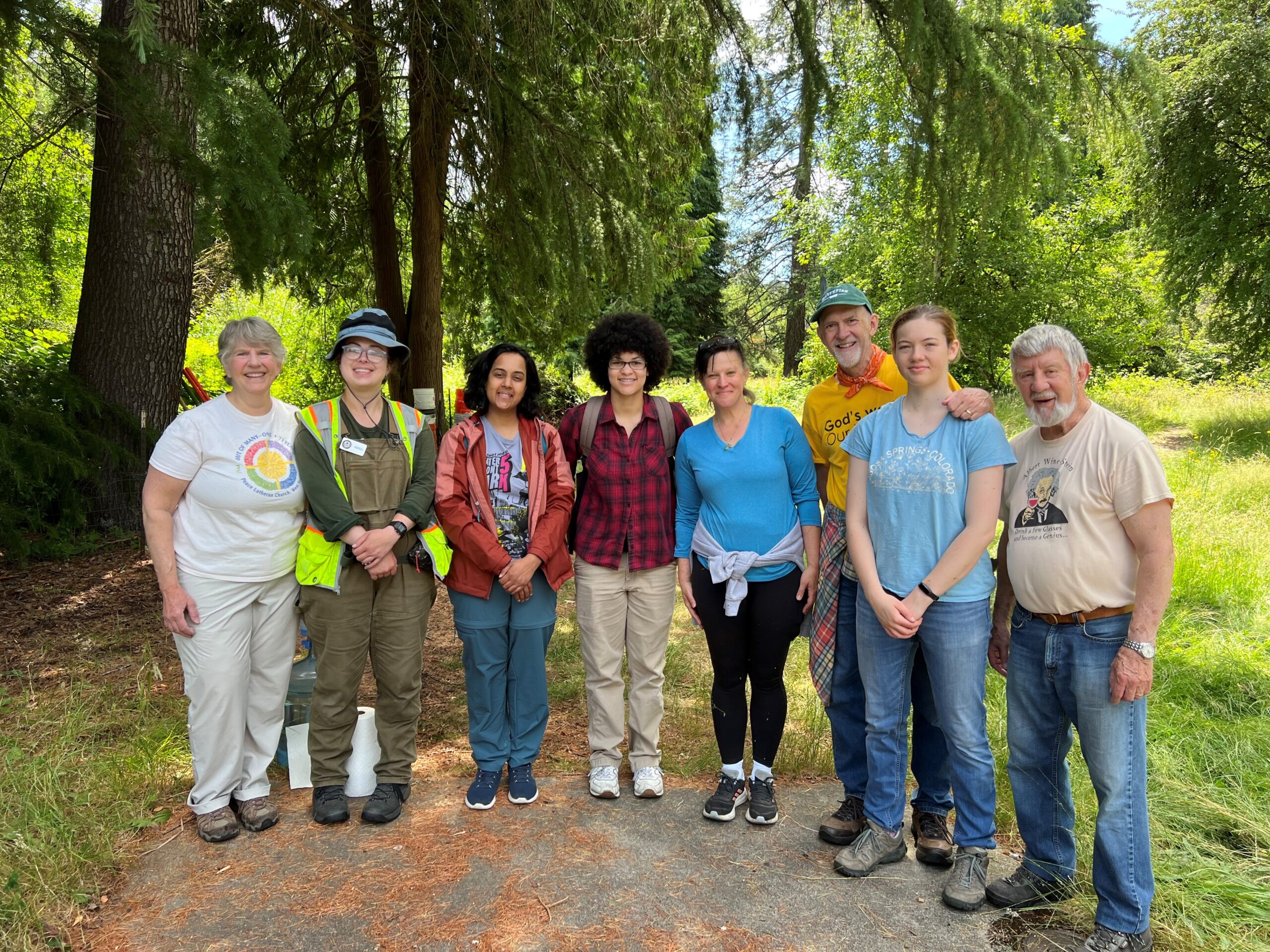 On Saturday, June 28, a crew of us joined Dirt Corps staff for a “God’s Work—Our Hands” event in the Longfellow Creek watershed. Adrian, our guide, shared her knowledge about caring for trees during the hot summer, including mulching, and then we loaded buckets and wheelbarrows to put the theory into practice. Over the course of those three hours one of the new friends I met was Aditi, an engineer working for a Seattle based company who recently moved here from her home in Bangalore, India. As we spread mulch with our rakes in a copse of cedar trees, we fell into a conversation about water, watersheds, and how water plays such a huge role in both Christian and Hindu spiritual traditions. It felt as if our conversation could go on for hours. I told Aditi about how our congregation has focused energy on water stewardship; about our Season of Creation—connecting the dots between our lives of faith and the natural world; I mentioned Camp Lutherwood, where the summer theme is WATER OF LIFE; and I told her about the Potluck Project and its goal of bringing people of diverse traditions together for genuine encounters as human beings. Our serendipitous encounter had the aroma of the Spirit about it. My fervent hope is that future Potluck Project gatherings will include people like Aditi, along with Muslim and Jewish community members and other neighbors for an encounter full of discovery and common ground.
When Naaman the Syrian–at the advice not of his king but rather of his wife’s servant girl–crossed into enemy territory to seek healing from the prophet Elisha, he entered both literally and figuratively into a watershed moment. Initially reluctant, he finally agreed to follow the order Elisha had given and washed in the Jordan River seven times. And rising from the river the final time he looked at himself and saw that his skin was restored. So deeply moved was Naaman that he insisted on bringing two donkey loads of soil from Jordan’s watershed back home with him so that he would remain forever connected to the place where his healing took place. Naaman’s encounter with Elisha, and the watershed of Grace his experienced, changed his life forever.
What is the antidote to all the efforts in our country being aimed toward instilling fear, dividing communities, sending people into exile, and limiting basic human rights? Surely the antidote isn’t another slew of Instagram posts or Facebook rants. The antidote, I believe, begins with ordinary people gathering physically around a shared meal, learning one another’s stories and listening for clues about the larger story that God is telling. A story of healing, of mercy, of peace.
With you on the Way,
Pastor Erik

 We are a

 What does this mean?
