
Archive for the ‘Newsletter’ Category

Naaman went down and immersed himself seven times in the Jordan, according to the word of the man of God;

his flesh was restored like the flesh of a young boy, and he was clean.

2 Kings 5:14

Dearly Beloved,

By every measure he came out on top.  He was a leader esteemed by his peers and revered by those who served under him.  A warrior whose acumen on the battlefield provoked fear in his enemies; a commander of distinction whose unswerving loyalty had earned him the trust of his king.  But in spite of all the accolades, there was one weakness he could not hide: Naaman was afflicted with leprosy. And this undeniable fact—this highly visible disease over which he had no control—threat­ened to define his life.

Leprosy and other skin maladies, in ancient as well as modern times, have long stuck fear in the hearts of those who’ve contracted them, and their families. A colleague of mine, who once served a parish on the Hawaiian island of Molokai, spoke of the history of the community of Kalaupapa, which for a century served as a colony for people with leprosy—or Hansen’s disease as we now call it. Despite the advent of new and effective treatments, he said social prejudices continued to prevail. During his tenure at Kalaupapa, church groups who came to the island to work on service projects invariably left something behind when they departed. In the dorm where they had stayed he’d invariably find a garbage sack.  Its contents?  All the clothing they’d used while they were on the island. 

It takes a great deal of effort—internal commitment combined with outward practice—to move beyond the baked-in assumptions and prejudices that are run through our veins and run through our world today and, to a greater or lesser degree, always have.  But that journey can begin with a simple step.  That’s the premise of the POTLUCK PROJECT, the brainchild of Paths to Understanding, an organization led by Pastor Terry Kyllo committed to bridging bias and building community through multifaith peace keeping.  The Potluck Project builds upon a model of community-making that Jesus himself used throughout his ministry: gathering with diverse people for a shared meal.  It was at these meals that Jesus taught about the Kin-dom of God.  It was at these meals that he challenged religious leaders not to allow MERCY to be trumped by concerns about PURITY.  It was at these meals that he coached his apprentices with stories, preparing them to carry on with his mission after he was gone.  His words, “DO THIS TO REMEMBER ME,” apply not only to the institution of the Lord’s Supper—they apply to the modus operandi Jesus used to engage the world.

Over the past year I’ve been cultivating the opportunity for our congregation to join the Potluck Project. Now, at last, the first concrete steps are in place and I invite you to be part of them.  Rabbi Allison Flash of the Kol HaNeshamah Synagogue and I are committed to bringing our communities together using the model developed by Paths to Understanding, and we now have TWO DATES ON THE CALENDAR: Sunday, Sept. 14, 5:30-7:30, and Sunday, Feb. 1st, 5:30-7:30pm.  Please mark your calendars and plan to be part of this important movement!  These planned events are the beginning of what we hope will be an expanding opportunity to bring diverse neighbors together—including folks of other faith traditions or none.  I am looking for people to join a planning team for these events, which we hope to extend beyond the first two initial gatherings.  If you are open to being part of such a team, please let me know.

Last week Marcia Olson and I paid a visit to Fatima Adam, a staff member of Hope Academy, a charter school serving Muslim children that is housed on the property formerly belonging to St. James Lutheran in White Center.  Fatima, along with her sister Asia, who I met with earlier this year, have been eager to learn about the history of St. James church and its commitment to serving the larger White Center community.  It was great to have Marcia along to share some of that history.  At the end of our time together, Fatima said something that has stuck with me: “There is a story God is telling here,” she said.  “You were part of that story.  Now we are part of it.  We don’t know long we’ll be here, but we know that God’s story will continue.” 

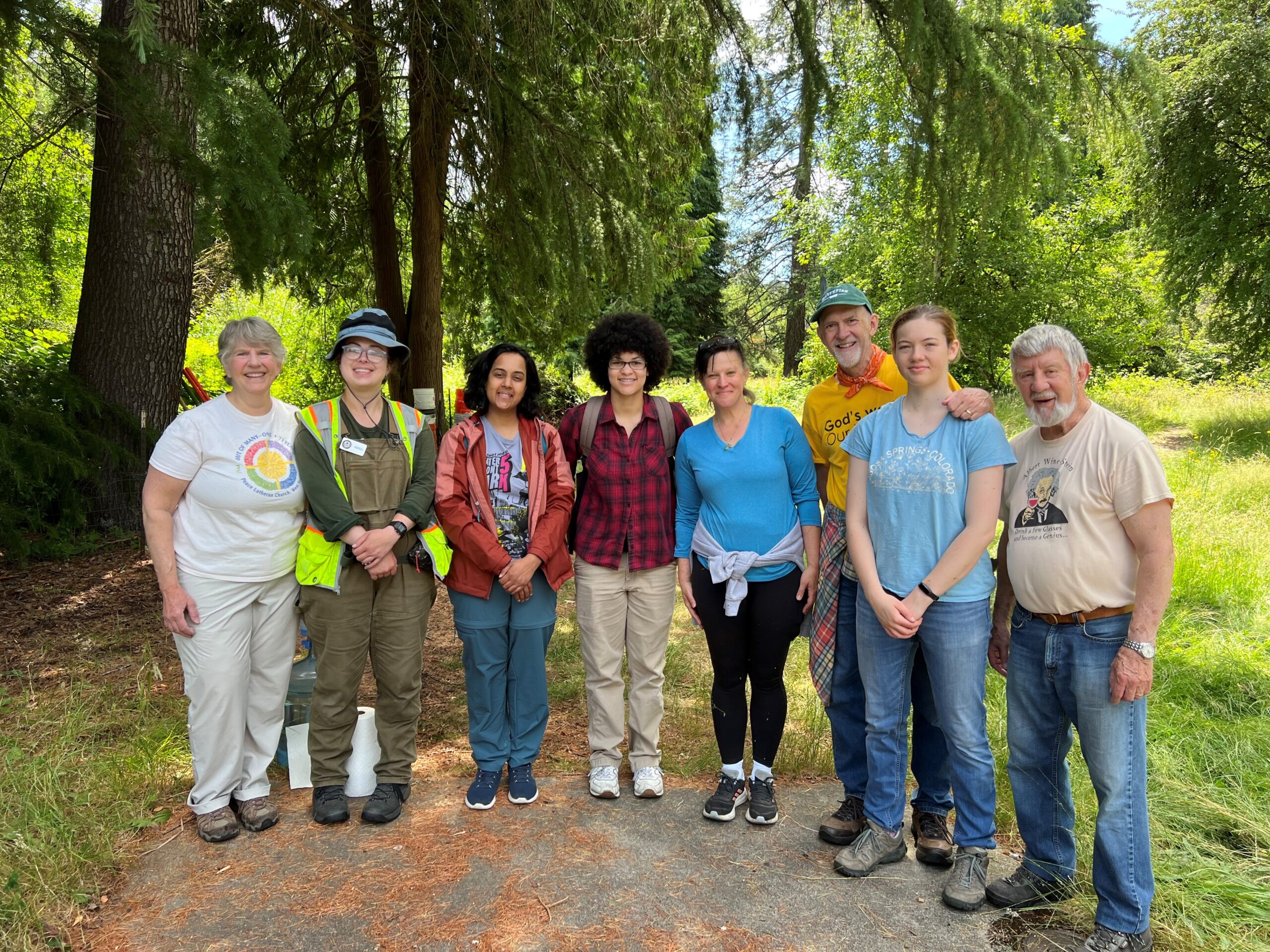
On Saturday, June 28, a crew of us joined Dirt Corps staff for a “God’s Work—Our Hands” event in the Longfellow Creek watershed.  Adrian, our guide, shared her knowledge about caring for trees during the hot summer, including mulching, and then we loaded buckets and wheelbarrows to put the theory into practice.  Over the course of those three hours one of the new friends I met was Aditi, an engineer working for a Seattle based company who recently moved here from her home in Bangalore, India.  As we spread mulch with our rakes in a copse of cedar trees, we fell into a conversation about water, watersheds, and how water plays such a huge role in both Christian and Hindu spiritual traditions.  It felt as if our conversation could go on for hours.  I told Aditi about how our congregation has focused energy on water stewardship; about our Season of Creation—connecting the dots between our lives of faith and the natural world; I mentioned Camp Lutherwood, where the summer theme is WATER OF LIFE; and I told her about the Potluck Project and its goal of bringing people of diverse traditions together for genuine encounters as human beings.  Our serendipitous encounter had the aroma of the Spirit about it.  My fervent hope is that future Potluck Project gatherings will include people like Aditi, along with Muslim and Jewish community members and other neighbors for an encounter full of discovery and common ground.

When Naaman the Syrian–at the advice not of his king but rather of his wife’s servant girl–crossed into enemy territory to seek healing from the prophet Elisha, he entered both literally and figuratively into a watershed moment.  Initially reluctant, he finally agreed to follow the order Elisha had given and washed in the Jordan River seven times.  And rising from the river the final time he looked at himself and saw that his skin was restored.  So deeply moved was Naaman that he insisted on bringing two donkey loads of soil from Jordan’s watershed back home with him so that he would remain forever connected to the place where his healing took place.  Naaman’s encounter with Elisha, and the watershed of Grace his experienced, changed his life forever. 

What is the antidote to all the efforts in our country being aimed toward instilling fear, dividing communities, sending people into exile, and limit­ing basic human rights?  Surely the antidote isn’t another slew of Instagram posts or Facebook rants. The antidote, I believe, begins with ordinary people gathering physically around a shared meal, learning one another’s stories and listening for clues about the larger story that God is telling.  A story of healing, of mercy, of peace.

With you on the Way,

Pastor Erik 


When you send forth your Spirit, we are renewed!  We are renewed!  – Psalm 104

Children of the Spirit!

It’s easy to be discouraged when we get caught in a pattern of “doom scrolling” through the 24/7 news cycle, shaking our heads at the latest political news and finding our limbic brain hijacked by what we see and read there.  For political party strategists of every stripe, “reactionary mode” is exactly where they’d like us to stay—at least long enough to motivate us to “click” the donation button before we move on.  I’m trying to limit my intake of news beyond a certain time each day, lest my dream life assume the same “gloom and doom” character that dominates our civic landscape. 

As we get ready to celebrate Pentecost Sunday, I wonder if our ancestors in the faith might have something to teach us about how to deal with all the eruptions and disruptions we experience around us?  After all, the first generation of Jewish Christians lived with all the hard realities of Empire.  It was not an easy existence with the ever present threat of violence hanging in the air, the crushing weight of Roman taxes, the uncertainty about the future, the contempt for both their Jewish roots and their emerging faith centered in Jesus as Messiah.  He, their teacher and now risen Lord, had offered them a Way to be in the world; a Way that did not look to the Empire for authentication but was rather an antidote to Empirical might; a Way that welcomed and included those who were sidelined, devalued, and disenfranchised; a Way that opened the door to community with others—including (most radically) non-Jewish neighbors. 

In Luke’s gospel the risen Christ spends 40 days among the disciple community preparing them for what comes next— the outpouring of the promised Holy Spirit.  During those days Jesus teaches them why everything he told them while he was with them had to be fulfilled…his suffering, his death, his rising.  All of it was a prelude so that the life-changing message and power of forgiveness would be poised to make its way around the world.  “You-all are the first to hear it, the first to see it, and you’ll be the first to tell it,” he told them.  “I’ve chosen you to be my witnesses, in Jerusalem, Judea, Samaria, and to the ends of the earth.” (Definitely a commencement vibe to his speech, don’t you agree?)

The overriding spirit characterizing his waiting community was that of JOY.  In the midst of all the challenges they faced, all the demands of Empire, all their existential struggles, they refused to be DIS-couraged—for their risen Lord was in their midst—first in the flesh and now through the Spirit.  I think it’s time for us to seize that JOY and claim it for ourselves!


They will hunger no more, and thirst no more; the sun will not strike them, nor any scorching heat; for the Lamb at the center of the throne will be their shepherd, and he will guide them to springs of the water of life, and God will wipe away every tear from their eyes. – Revelation 7:16-17

Easter people!

The recent loss of my older brother Peter to cancer has me contemplating life’s gifts and liabilities.  He is the first of my seven siblings to leave this embodied life behind for the “life of the world to come.”  How many other siblings will I lose before my name is called?  I’m not looking forward to finding out.  Yet, in the midst of this time of grief I’ve been blessed with many memories from the 68 years we shared together.  Like the time we played on the same Little League team in Havre, Montana, squinting into the bright plains sun on a field that, instead of green grass, featured brown hardpan with weeds springing up from the cracks. Or the times when our quarreling voices reached fever pitch and Mother would banish us to the garage to “work things out” by ourselves.  Or the time we clandestinely set off forbidden firecrackers in the dirt hills behind our neighbor’s backyard—and in the process accidentally ignited a grass fire that left us panicked—a fire we, fortunately, were able to put out. 

My brother Peter

But the times I hold most dear are the ones when we played football together—he the quarterback and I the receiver.  He’d use his finger to draw up plays on the front of his T-shirt—post routes, flag routes, button hooks—and I’d run them; a pattern we continued again and again over the years.  Peter liked calling the plays, liked being in charge—and he was good at it.  By his senior year in high school he was the starting quarterback for the Albert Lea Central High “Tigers.”  When he later went to Law School it was the obvious choice. Not only because he’d been polishing his arguing skills at home his entire life—but because his clients would know, beyond a shadow of doubt, that he, their advocate—their quarterback—would seize upon the best legal strategy, execute it skillfully, and carry the team to victory.

When it comes to matters of life and death, who do you unfailingly count on?

When Barbara Brown Taylor was asked how she was approaching another season of Lent and resurrection, she responded:[1]

“When you’re in your mid-70s, you’re going to funerals a lot.  So resurrection in a season where so many close ones and Earth herself is in a kind of permanent crucifixion—it helps…to pull the hopefulness in close and attach it to something I can do today, small as it can be. Fill the bird feeders. Make somebody’s day better instead of worse.

“There’s huge surrender in resurrection.  Am I willing to go down to the dust with faith that consists entirely of saying, ‘I trust the one that takes me from there’?  And if it takes me back into carbon molecules and puts me in a bird bone, that’s good enough for me.  A lot of Lent and Easter is about not getting the cup you want, and it’s about drinking the cup.  It’s about trusting your friends to finish what you started, and maybe you have less time that you thought to get done what you wanted to get done.”

Peter was originally diagnosed with lung disease in 2005 and given a two-year prognosis.  By the grace of God he lived another 20 years; long enough to watch his and Gabrielle’s four children, Jacob, Lars, Anneliese, and Soren, finish high school and college, choose careers, find life partners, get married, and begin having children.  Peter had 4 “bonus” years after receiving a double lung transplant on Reformation Sunday in 2020.  Through all the doctor visits, the anti-rejection medications, and all the rest he endured, he didn’t complain.  He found reasons to be thankful.  He continued his professional work as an advocate until the final days of his life, often representing clients who had been taken advantage of by the corporations or organizations for whom they worked.  Throughout all of this, Peter spoke time and again about trusting God with his life.  Did he want more than the 69½ years he got?  Of course; don’t we all?  But he was at peace with trusting that his Lord would unfailingly accompany him to where the springs of the water of life flow; to that new heaven and earth where all tears will be wiped away.

The Gathering Hymn we sang at his memorial was the same one we sang at his and Gabrielle’s wedding: JOYFUL, JOYFUL WE ADORE THEE, based on Beethoven’s Ode to Joy. Here’s verse three:

Thou art giving and forgiving, ever blessing, ever blest. Well-spring of the joy of living, ocean depth of happy rest!  Thou our Father, Christ our brother, all who live in love are thine; teach us how to love each other, lift us to the joy divine!

The refrain of the Easter season is clear: I will not leave you orphaned, says Jesus.  Not even death can separate us, for I am with you always—to the end of the age.  That’s a refrain followers of the risen One keep on singing—with gusto!—even in the face of death.

With Resurrection Joy, 

Pastor Erik


[1] Sojourners.  April 2025 edition, p. 27

“Woe is me! I am lost, for I am a man of unclean lips, and I live among a people of unclean lips; yet my eyes have seen the King, the Lord of hosts!”  – Isaiah 6:5

Beloved of God,

When Isaiah heard the voice of God calling his name one day in the Temple, he began looking for a way out.  After all, who was he—a man of unclean lips—to take on a Divine vocation as a prophetic spokesman for God?  Isaiah wasn’t alone in looking for a way around God’s call.  Moses tried to use a speech impediment as his excuse for not answering God’s call.[1] For Jeremiah the excuse was age.  “I’m too young to serve as a spokesman for the Almighty.”[2] Gideon came from the very least family of the weakest clan of a beleaguered people —and couldn’t imagine how he could possibly be of any use to God.[3] Isaiah, likewise, was eager to find a way far from the line of fire.  But none of these leaders were finally able to elude God’s call to servanthood. Each of them thought their personal limitations were too big to be overcome.  And in each case, God provided what was needed in order for them to succeed.  They each became instruments of God’s purposes in spite of their limitations. God’s strength was made perfect in their weakness. The point?  God can take whatever raw material we provide and fashion it into an instrument that’ll keep working under the most challenging conditions imaginable.  And the challenges of living faithfully as citizens of God’s “kin-dom” and as citizens of our country are reaching new depths these days.

On February 1, in a widely distributed post on X (formerly Twitter), Lutheran organizations like Global Refuge (formerly Lutheran Immigration and Refugee Service) and Lutheran Services in America were denigratingly characterized as “money laundering operation(s).”  This baseless and slanderous accusation was amplified by Elon Musk who commented that the DOGE team is “rapidly shutting down these illegal payments.”  In a follow-up communication, Presiding ELCA Bishop Elizabeth Eaton pointed out the baseless and defamatory nature of these comments. “Neither claim,” she said “was accompanied by proof to support the false and dangerous notion that Lutherans use religion to launder money or that grants to support the work of Lutheran organizations for decades are in any way illegal.  The Lutheran organizations targeted by name in these false claims on X have done the same work for 85 years—beginning during World War 2—in serving legally admitted refugees and immigrants.”  Bishop Eaton concludes: “The ELCA remains committed to our core mission of feeding people who are hungry, caring for those who are sick, and advocating for justice, peace, and the dignity of all people. This has been the calling of the church for over 2,000 years, and that will not change.”  Bravo, Bishop Eaton!  All of us who serve Christ’s church during this extraordinary time are being summoned by the gospel to stand together against the threats that would impede the church’s mission and imperil the rule of law, and Constitutional democracy.  The time is at hand.

Pastor Martin Niemöller (1892–1984) was a prominent Lutheran pastor in Germany who was initially sympathetic with many Nazi ideas. But after Hitler came to power in 1933, he became an outspoken critic of Hitler’s interference in the Protestant Church and as a result spent eight years in Nazi prisons and concentration camps.[4] On June 8, 2023, the 37th anniversary of my ordination, I visited the cell where Niemöller was imprisoned at the Sachsenhausen concentration camp north of Berlin. After the war, Niemöller spoke openly about his own early complicity in Nazism and his eventual change of heart. His powerful words about guilt and responsibility still resonate today.

“First they came for the socialists, and I did not speak out—because I was not a socialist.

Then they came for the trade unionists, and I did not speak out—because I was not a trade unionist.

Then they came for the Jews, and I did not speak out—because I was not a Jew.

Then they came for me—and there was no one left to speak for me.”

Rev. Martin Niemöller, German Lutheran Pastor, commenting on the Nazi period

By the time Isaiah’s encounter with God ended, his reluctant “Woe is me!” had become a resounding “Here am I—send me!” Newly cleansed and empowered, Isaiah assumed the prophet’s mantle.  What he and those he mentored proclaimed in God’s name has withstood the test of time.  Jesus turned to Isaiah to encapsulate what his mission was about—and those words are still relevant today.

What ministry at the intersection of Faith and World is God calling you to engage?  How can we together faithfully pursue the mission to which Christ is calling us in these times?  We cannot run away from this moment.  We must embrace it.

With you on the Way,

Pastor Erik

[1] See Exodus 4:1-17

[2] See Jeremiah 1:4-10

[3] See Judges 6-8

[4] For more information, see the Holocaust Encyclopedia, https://encyclopedia.ushmm.org/content/en/article/martin-niemoeller-first-they-came-for-the-socialists

“To everything there is a season, and a time for every purpose under heaven.”  – Ecclesiastes

Dearly Beloved,

With 2024 now behind us, we’re entering a milestone year—2025—a number which tells us we’re a quarter of the way through this century.  Will 2025 prove to be notable for other reasons?  As always, predictions vary widely, and it always seems easier to project negative trends than it is to predict positive ones.  As a new administration takes over the West Wing we can surely expect some turbulence, but how much and in what areas of our common life?  Artificial Intelligence (A.I.) and quantum computing tools will roll out at an increasingly rapid pace, making life either significantly easier to cope with or exponentially more difficult to manage, depending on one’s point of view.  Climate challenges, human-on-human violence—these will all be in the mix.

Most certainly, life in 2025 will bring new highs and lows to our individual journeys and the human journey.  So we pray: God, grant me the serenity to accept the things I cannot change, the courage to change the things I can, and the wisdom to know the difference.  In all of this, what role will faith play for us? The quotation below from James Kay has become a centering one for me in recent years:

“If the future were not the promise of Jesus Christ but the predictable outcome of present trends, despair would overwhelm us,” writes Kay.  But the message we cling to as people of faith is that “we can never take our own projections more seriously than God’s promises.”

All manner of things—good, bad, and in between—will unfold for us in 2025.  To weather it all, we must remind ourselves—and each other—that we are companioned by a Lord who will not leave or forsake us.  Yes, we put our trust in the crucified and risen One, who will accompany us come hell or highwater, all the way through the alley!

Last month I joined my five brothers at the home of eldest brother Peter and his wife Gabrielle in Southern California.  In recent months, cancerous melanoma has spread to Peter’s lungs and brain, and he’s receiving treatment.  We traveled there to share our love and support with Peter directly.  In the days just prior to the trip, the Santa Ana Winds blew fiercely, as they are wont to do this time of year, forcing hot desert air down into the L.A. basin.  These winds can reach speeds of up to 80mph and are particularly dangerous during fire season—which, during this dry year, has extended into winter.  On the plane ride down to L.A. I read about a fire in the mountains above Malibu that, egged on by the Santa Ana winds, threatened to blow up. Those mountains were visible from Peter’s home.  I wondered what I would encounter when the plane landed.

Low and behold, by the time the plane touched down the winds had ceased, the sky was blue, and the worst seemed to have passed.  As my brother Joel and I took the exit for Peter’s neighborhood, we could see the huge column of smoke and orange flames on the ridge not 10 miles away.  But, blessedly, the absence of wind meant the fire danger had lessened considerably.  And by the next morning a cool, moist marine layer had moved in, making the fire much more manageable for firefighters and less likely to derail our plans.

On our final afternoon together we gathered around the kitchen table in Peter and Gabrielle’s home for an improvised liturgy bookended by two psalms: Psalm 133 (“Behold how good and pleasant it is when brothers live together in unity…”) and Psalm 121 (“I lift my eyes to the hills; from where is my help to come?  My help comes from the LORD, make of heaven and earth.”)  These pithy Psalms of Ascent—were sung by pilgrims as they made their way from their hometowns up to Jerusalem for various festivals.  I like to imagine Jesus learning them by heart as he traveled with his parents during his growing up years.  The time we brothers shared was precious, “like the oil running down upon the beard of Aaron…like the dew of Hermon falling on the maintains of Zion”; not only because of the many stories which were invoked and shared, but because we experienced a power greater than ourselves surrounding and holding us close: the LORD “who neither slumbers nor sleeps…who keeps our going out and coming in from this time on and forevermore.”  After the AMEN, we stood and sang in unison, as only brothers can, a stanza of the hymn we had sung 40 years earlier during Peter and Gabrielle’s wedding:

Joyful, joyful we adore thee, God of glory, Lord of love!

Hearts unfold like flowers before thee, praising thee, their sun above.

Melt the clouds of sin and sadness, drive the gloom of doubt away.

Giver of immortal gladness, fill us with the light of day!

For everything there is a season.  And for us who hold Jesus, crucified and risen, as our Lodestar, each season, whatever its content, is laden with hope.  Not a hope based on optimism in human abilities or achievements but a hope invested in him whom death itself could not hold captive.  As this new year begins it is with Jesus Christ that we plant our stake in the ground.

With you on the Way,

Pastor Erik


Lift up your eyes and ask yourself who made these stars….calling each by name?  Because God is so great in strength, so mighty in power, not a single one is missing.  How can you say… “my destiny is hidden from YHWH, my rights are ignored by my God?”  Do you not know? Have you not heard?  YHWH is the everlasting God, the Creator of the ends of the earth.  This God does not faint or grown weary; with a depth of understanding that is unsearchable.

Isaiah 40:26-28

Dear Waiters and Watchers,

I always look for them, casting my eyes upward as I wheel the garbage to the street on winter nights; searching the sky for a break in the clouds and a window to the heavens.  And in those moments when I do catch a glimpse of the stars, something in me expands and I feel transported from this lowly life to a place that is greater.  Do you know what I mean?

The dimensions of our galaxy, the Milky Way, are mind-boggling—up to 400 billion stars—and perhaps at least as many planets—arranged in a giant spiral disk of stars, dust, and gas measuring 100,000 light-years in diameter.  Astronomers tell us that our own solar system, arrayed around a single one of those stars, is located in the “outer suburbs” of our galaxy, 27,000 light years from the galaxy center.  To put it in more accessible terms, if our solar system was the size of a quarter, our galaxy would be 1,200 miles in diameter.  And here’s the clincher: the Milky Way is but one of perhaps 500 billion galaxies!

So many sources of light and so much energy and mass given to producing it.  And yet, within this vast universe, it’s the nonluminous material—the DARK MATTER and DARK ENERGY—that constitute together 95% of the total mass of the universe.  To say it another way, 95% of the universe is cloaked in mystery.  Does dark reveal anything to us about God?

It’s December and the season of Advent is upon us.  Coming to us in the northern hemisphere as daylight wanes and nights grow long, ADVENT is often awash with metaphors of LIGHT and DARKNESS.  So often in these scenarios LIGHT is associated with all that is good and right and true, while DARKNESS is associated with all that is bad and false and wrong.  Yet from the beginning, as the first chapter of Genesis illustrates, darkness and light have com­plementary roles to play within God’s magnificently unfolding universe.  When God creates the light, the darkness is not extinguished or cursed, but is integrated into the rhythm of the daily round.  Light and darkness each have purpose in the created order.

Imagine, if you can, a world that lacked Daytime or lacked Nighttime.  Imagine Scripture’s saving story told without NIGHT, without DREAMING.

  • No starlit sky to which Abram gazes while God affirms the promise.
  • No midnight vision for Jacob while fleeing his brother, no Jacob’s ladder.
  • No divine – human wrestling match at the ford of the Jabbok.
  • No prison-borne dreaming that leads Joseph to ascendancy under Pharoah.
  • No pillar of fire by night guiding and protecting Moses and the Hebrew children as they move out of slavery, through the Red Sea, and onto their wilderness journey to the Promised Land.
  • And two millennia later, no Messenger in the dark whispering to another Joseph: FEAR NOT TO TAKE MARY AS YOUR WIFE, FOR THE CHILD SHE CARRIES IN HER DARK WOMB IS HOLY.

Every life form on this planet home has evolved under the influence of night and day, darkness and light, and life as we know it could not exist without their DANCE.  Our Advent invitation this year is to stay alert to ways of imagining darkness and shadow NOT as attributes to be shunned, but rather as attributes to be hallowed.

In the shadow of your wings I will praise your name, O God!

During Wednesday evening gatherings this season we will explore this theme.  And on both Sundays and Wednes­days Scripture readings, hymns, and songs will build upon the theme that God’s presence is made manifest in light and dark and shadow.  Consider joining us.

“Hope begins in the dark,” writes Elizabeth Hunter.  “In deep, dark, winter soil little seeds nested underground are kept safe and nurtured.  When skies are dark, stars can be seen more clearly. In darkness, the natural sleep cycles of nocturnal animals and migratory patterns of birds are undisturbed.  Darkness has many benefits.”[1]

In the short story NIGHTFALL, Isaac Asimov tells the tale of the fictional planet Lagash, whose six suns keep it perpetually in light.  Residents of this fictional world experi­ence a star-filled nighttime sky only when astronomical factors perfectly align once every 2050 years.  For a brief period during this rare interlude all six suns fall away from view, exposing the inhabitants to the dark, starry sky.  The affect, however, is not awe and wonder but rather pandemonium.   Nyctophobia—irrational fear and foreboding  of the night—grip the populace of Lagash, unleashing internal forces so intense that the result is the complete destruction of the planet’s civilization. Survivors are left to build their lives—and their civilization—over from scratch.  Asimov’s tale is a fascinating take on the notion of perpetual light as a fiendishly potent enemy.  Might it also serve as a warning to a society which has elevated “whiteness” onto the pedestal superiority and consigned “blackness” to the dungeon of inferiority?

From the beginning darkness and light, day and night have been necessary components of the unfolding story God is telling.  Parts of a single whole, both are declared GOOD.  And both are seedbeds for our social and spiritual lives.  Absent one, the other suffers immeasurably.  Fourth century Cappadocian monk Gregory of Nyssa flipped the West’s social/spiritual paradigm on its head when he wrote: “Moses’s vision began with light.  Afterwards God spoke to him in a cloud.  But when Moses rose higher and became more perfect, he saw God in the darkness.”[2] What rich, new insights become available to us when we’re willing to explore the precincts of the night!

I leave you with one verse of a hymn by Brian Wren that we’ll be singing this month:

Joyful is the dark, holy, hidden God, rolling cloud of night beyond all naming:

majesty in darkness, energy of love, Word-in-flesh, the mystery proclaiming!

Blessed Advent(ure)!

Pastor Erik

[1] Elizabeth Hunter quoting Anne Lamott, Hope Begins in the Dark, in her article in Gather Magazine, November/December 2021 Issue, page 1.

[2] Quoted by Barbara Brown Taylor in Learning to Walk in the Dark, p. 48

Finally, beloved, whatever is true, whatever is honorable, whatever is just, whatever is pure, whatever is pleasing, whatever is commendable, if there is any excellence and if there is anything worthy of praise, think about these things. Keep on doing the things that you have learned and received and heard and seen in me, and the God of peace will be with you. – Philippians 4:8-9

Beloved of God,

Astronomically speaking, November is a liminal month.  Each year we turn our clocks back, pull warmer coats and hats out of the closet, and prepare for the “long dark” as we watch daylight diminish and see the sun’s arc move lower in the sky.  November is also a liminal time within the Church Year.  It begins with the Feast of All Saints: remembering the faithful people of all times and places whose lives were captured by the gravity of grace, along with those individ­uals dear to us who, though no longer living, continue to impact our lives.  It ends with the Feast of Christ the King and the promise that in the end, evil will be vanquished and the Lamb who was slain will reign over a renewed heaven and earth. Finally, November is a liminal time within our common life: election time.  After all the speeches have been given, all the arguments made, all the ads posted and polls taken, it is, at last, decision time.  The texts and themes we’ll hear during November speak of End Times and counsel us not to become so swept up in the perils and predictions of the moment that we allow them to infect us with anxiety.  In the words of the great civil rights folk song, we are to “keep our eyes on the prize and hold on.”

St. Paul, writing from prison (quote above), invited the Christians of Philippi to put the circumstances they faced into a larger frame by focusing each day on “whatever is true, honorable, just, pure, pleasing, commendable, excellent, and worthy of praise.” “Keep on doing the things that you have learned and received and heard and seen in me,” says Paul, “and the God of peace will be with you.”

As we countdown to one of the more contentious and consequential presidential elections in American history, we do well to take Paul’s dose of wisdom and make it our own.  Whatever the world may look like in the days and weeks after November 3rd, God will still be there with his promises, and our mission as a congregation will still be be­fore us: TO CULTIVATE FAITH AND TRUST IN OUR LIFE TOGETHER, TO DISCERN GOD’S CHALLENGE INTO UNFAMILIAR PLACES, AND TO VENTURE BEYOND OURSELVES SO ALL PEOPLE WILL EXPERIENCE GOD’S LOVE. [PLC Mission state­ment]  “Remember who you are and what it means to be a community in Christ,” says Paul, and that is indeed what you and I, together, are to be about.

The COMMUNITY PRAYER VIGIL we will host at Peace the evening of November 3rd, All Saints Sunday, is one way we’ll walk that talk.  Against all the hyperbolic, offensive, and controversial language of this campaign season, we will offer a counterpoint: space for contemplation and prayer; for lighting candles and keeping hope burning, “come what may.”

With you on the Way,

Pastor Erik


St Francis mural Eager-to-Love_WP“We know that the whole of creation has been groaning together as it suffers together the pains of labor, and not only the creation, but we ourselves, who have the first fruits of the Spirit, groan inwardly while we wait for adoption, the redemption of our bodies.”  – Romans 8:22-23

Beloved of God,

Autumn is here and with it the return of Sunday morning faith formation classes and opportunities galore for putting our faith into practice. Where will your energies be focused?  Read more about the options in this edition of Peace Notes.

Each October begins with the Feast of St. Francis of Assisi (observed this year on Sunday, October 6).  While we at Peace mark our Season of Creation in June each year, in many ecumenical circles the Season of Creation begins September 1st and ends October 4th.  This year we’re marking the end of the ecumenical season by uniting with Christian communions around the theme, “To hope and act with Creation,” inspired by Romans 8:19-25.  It’s a practice we’ll continue going forward.

When Francis heard the Lord speak to him, saying “Francis, rebuild my church,” he took up that call in earnest.  Divesting himself from his family wealth, Francis embarked on a new path.  While he could easily have become the respected leader of a successful monastic community, removed from the distractions of society, he chose instead to immerse himself in the messy human condition, where he was often reviled as an embarrassment to the high society from which he came. Rather than accept a traditional endowment, Francis and his followers begged in the streets for bread, bricks, and firewood. He tended the sick and cared for orphans. He stood up against oppression wherever he encountered it, but he did so in such a loving way that he posed no obvious threat to the authorities and so managed to convert them to his cause.[1]

“The early Franciscan friars and the Poor Clares (women who followed Clare of Assisi) wanted to be gospel practitioners instead of merely “inspectors” or “museum curators,” writes Franciscan Father Richard Rohr.  “Both Francis and Clare offered their Rules as a forma vitae, or “form of life.” They saw orthopraxy (correct practice) as a necessary parallel, and maybe even precedent, to mere verbal orthodoxy (correct teaching) and not an optional add-on or a possible implication.

“Creation itself—not ritual or spaces constructed by human hands—was Francis’ primary cathedral.

His love for creation drove him back into the needs of the city, a pattern very similar to Jesus’ own movement

between desert solitude (contemplation) and small-town healing ministry (action).” – Richard Rohr

Not only was Francis aware of the groaning and suffering of his fellow human beings, he was tuned to the groaning of all creation. The more he found God within himself, the more he saw God outside himself where every detail of nature spoke to him of God.[2]  Prayer led Francis into the truth of his own reality and into the truth of the world. Nothing was outside the embrace of God’s love.  In his famous encounter with the wolf who had been terrorizing the village of Gubbio, Francis addresses the wolf as a brother, and the wolf, who’d charged toward Francis ready to attack, “closed his mouth and stopped running, and came meekly as a lamb and threw himself at the feet of St. Francis.”[3]  Whether the story is factually true in every detail is beside the point, which is that when Francis opened his eyes to the vulnerable ones of the two-legged variety, his eyes were also opened to the vulnerable ones of the four-legged variety—and sensing his address as genuine, they responded.

The theme “To Act and Hope with Creation” reminds us that our actions, and our trust in the God who empowers such actions, enable us to glimpse the future with hope.  This fall there are a number of initiatives before us.  Initiative 2117 in particular, if passed, would have deep and devastating impacts on our efforts in Washington to slow climate breakdown.  We’re being encouraged by our partners at Earth Ministry and Faith Action Network, as well as our Creation Care Team, to vote NO.  (To learn more about what’s at stake, seek out a member of the Creation Care team.)  However we choose to fill out our ballots, let’s do so as informed voters, digging beyond the 30 second radio and TV sound bites before making our choices.

Hope is a precious commodity these days.  It’s so easy to be disappointed with outcomes – especially ones in which we’ve invested so much energy.  But to be followers of Jesus is to live with the conviction that hope is real even when there are no obvious signs pointing in that direction.  Building our connections to others in a nurturing community helps to move us beyond the isolation that can be so despairing.  Each week we have the chance to take that step by coming together around Word and Table—places where Christ promises to meet us without fail.

With you on the Way,

Pastor Erik

[1] Mirabai Starr, Saint Francis of Assisi: Brother of Creation (Boulder, CO: Sounds True, 2007, 2013), 22–23, 27–28.

[2] Ilia Delio, preface to Franciscan Prayer: Awakening to Oneness with God (Cincinnati, OH: Franciscan Media, 2024), vii–viii, ix–x.

[3] You can find an account of this event in The Little Flowers of Saint Francis, a 14th-century collection of stories about Francis and his companions.

Image credit and inspiration: Dimitri Kadiev, Be Praised—mural of Francis and Clare on the side of the CAC (detail), photo of paint on adobe wall. This mural art on the outside of the CAC represents Francis’ love and acceptance of life in its varied and diverse manifestations.

One of the scribes…asked Jesus, “Which commandment is the first of all?” Jesus answered, “The first is, ‘Hear, O Israel: The Lord our God, the Lord is one; you shall love the Lord your God with all your heart, and with all your soul, and with all your mind, and with all your strength.’ The second is this, ‘You shall love your neighbor as yourself,’  There is no other commandment greater than these.”

– Mark 12:28-31

Beloved of God,

After a week in August that saw some of the lowest temperatures in decades and the wettest August days of record, we’ve rebounded for a warm and beautiful weekend of summer—and I for one am relishing it!  Wherever this weekend finds you, I hope you can revel in God’s good creation while enjoying things you love!

As usual, our life in community at Peace is ramping up this month, with special events and opportunities awaiting your presence and participation.  Among them are the HABITAT INTERFAITH BUILD September 6/7 and 13/14 and our RALLY SUNDAY CELEBRATION on September 22nd with special guests Pastor Kevin Beebe and Ashleigh Ellsworth-Keller of Camp Lutherwood.  Please mark your calendars!  You can read more about these and other congregational events in the pages that follow.

In addition to our fall programming and the start of the school year, this autumn is being indelibly stamped by another occasion which will dominate our lives over the next two months—the most consequential election season of our lifetimes.  In recent years I’ve become alarmed by the rhetoric of the so-called Christian right as they wrap themselves in the flag, assume the title “patriot,” and claim divine sanction for their candidate of choice.  The language being used, and the actions they support, are downright idolatrous.  Blueprints are being formulated (such as Project 2025) that openly promote the end of democracy as we’ve known it—and do so in the name of God.  This cannot stand.

“Christian nationalism in the United States is a political ideology and cultural framework that seeks to fuse American and Christian identities. It suggests that “real” Americans are Christians, and that “true” Christians hold a particular set of political beliefs.  It seeks to create a society in which only this narrow subset of Amer­i­cans is privileged by law and in societal practice…Christian nationalism employs the language, symbols and imagery of Christianity…to advance its own aims.  It points not to Jesus of Nazareth but to the nation, as conceived of by a dangerous political ideology, as the object of allegiance.”

 – Amanda Tyler of Christians Against Christian Nationalism, writing in the Sept/Oct 2024 issue of Sojourners Magazine

While you and I may not always agree on the best course of action when it comes to candidates for office and propositions that come before us, as Lutherans we recognize our duty to participate in the democratic process as informed citizens, and to encourage others to do the same.  Our baptismal covenant includes: “serving all people and creation, following the example of Jesus,” and “striving for justice and peace in all the earth.”  Love for God and neighbor compels us to engage in conversations about public policy and other topics where the good of the community is at stake, with an eye toward maintaining justice and caring for the needs of the most vulnerable.

A group of Peace folk met recently to ask how we, as a community of faith, might respond to the rise of Christian nationalism and the claims that are being made in the name of “Christians.”  Let me know if you’d like to be involved in future meetings.  More bombastic voices is not the answer.  We need to do something more than add more fuel to the fire.  One option under consideration is partnering with the organization Paths of Understanding to host a Potluck for Democracy—which would bring together neighbors and members of other faith communities—Christian and non-Christion—for the purpose of genuine human encounter and bridge building.  One tenant of Christian nationalism is that people who are “different” from us (i.e. us white people) cannot be trusted.  Face to face engagement over a shared meal is one simple way of challenging that falsehood.  Jesus made that kind of meal fellowship a core part of his ministry and his teaching.  And he left his disciples the template for a Meal that they (that is, WE) have been carrying out in his name ever since.

The rhetoric of those who want to subvert our democracy and replace it with a system that privileges certain individuals who meet their criteria as “deserving Chrisitan Americans” must be challenged.  Those of us of voting age will have our chance at the ballot box on November 5th, but before we reach November we have the opportunity to offer an alternative narrative to the fearful and hateful ones that are being promulgated in the name of Christ.

With you on the Way,

Pastor Erik


But now in Christ Jesus you who once were far off have been brought near by the blood of Christ.  For he is our peace; in his flesh he has made both groups into one and has broken down the dividing wall, that is, the hostility between us. – Ephesians 2:13-14

Beloved of God,

There’s much talk about division within our country these days.  These divisions have always been present to a greater or lesser degree, but in recent decades they have become much more visible and vocalized.  As the upcoming election looms, it’s hard not to find ourselves and our personal position on candidates and issues hardening.  Human  division is nothing new; we Americans certainly didn’t invent it!  As the Biblical record (and anthropological evidence) attest, divisions within the human family have existed from the beginning, with one side or another often claiming divine sanction for their particular group’s point of view.

One of the divisions St. Paul addresses most frequently in his letters is the division between Jews and Gentiles, i.e. between those who are heirs to the promises God via the old covenant (Abraham and Moses), and those who are heirs to the promises of God mediated through the new covenant initiated in Jesus Christ.  In his Letter to the Ephesians Paul says there’s room for both – Jew and Gentile – in the new covenant God has initiated in Jesus.  In Christ, says Paul, God has accomplished something no one else could—through Christ’s self-giving sacrifice on the cross he has “broken down the dividing wall, that is, the hostility between us.”  Writing about this, Paul speaks not as if it may happen “someday, by and by,” but rather that it has already been accomplished!

So then you are no longer strangers and aliens, but you are citizens with the saints and also members of the household of God, built upon the foundation of the apostles and prophets, with Christ Jesus himself as the cornerstone.  – Ephesians 2:19-20

As followers of Jesus, the invitation for us is to look at our fellow human beings through the eyes of Christ, seeking opportunities to confirm our kinship rather than for evidence of irreconcilable differences between us.  Jesus himself practiced this when he gathered a diverse community of disciples around him and he did it often through table fellowship.  Wherever he went, he made mealtimes occasions for teaching that God can mend divisions that seem insurmountable.  His approach offended some religious leaders and confounded others. The Eucharistic Meal we share each week is a reminder of his radical promise to be fully present, offering himself and calling his diverse community of followers into unity.

Wherever we may find ourselves this summer, whether close to home or across the ocean, the invitation is for us to look for those things which unite us—evidence of our common humanity.  Responding to this invitation will no doubt stretch us beyond our comfort zones, as his invitations always do.  But what an adventure—to see if, in crossing into new territory, we don’t discover that the Spirit was already there before us!

With you on the Way,

Pastor Erik