Archive for the ‘Archive’ Category

Welcome to Peace!  We’re so glad you found us. Worship begins @ 9:30am.

God is the source of our nourishment. Jesus’ invitation to “take and eat…take and drink” is a repeated one. In holy communion, in the word read and proclaimed, in the assembly of the people of God, the dominion of God has come near. Rejoice! Your name is written in heaven.

Rev. Mel Jacob presided and Deb Hagen-Lukens was our preacher while Pastor Erik is away.

Deb’s sermon, based on Luke 10:1-11, can be found here: Peace Lutheran Church, Deb Hagen-Lukens sermon July 6, 2025.  

To join worship via our Live Stream channel, follow this LINK @ 9:30am.

The Worship Guide can be downloaded here: Pentecost 9C 7.6.25 bulletin

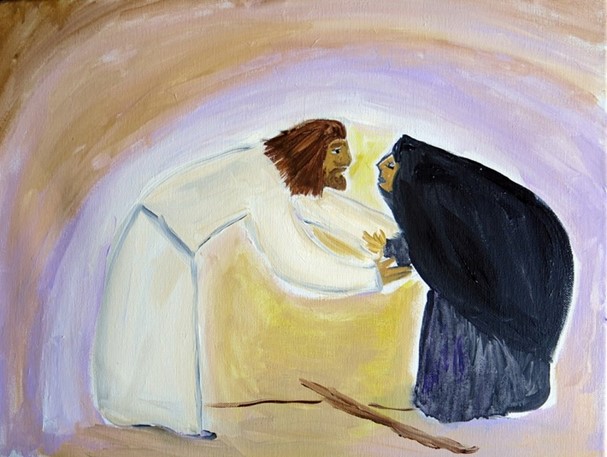
Naaman went down and immersed himself seven times in the Jordan, according to the word of the man of God;

his flesh was restored like the flesh of a young boy, and he was clean.

2 Kings 5:14

Dearly Beloved,

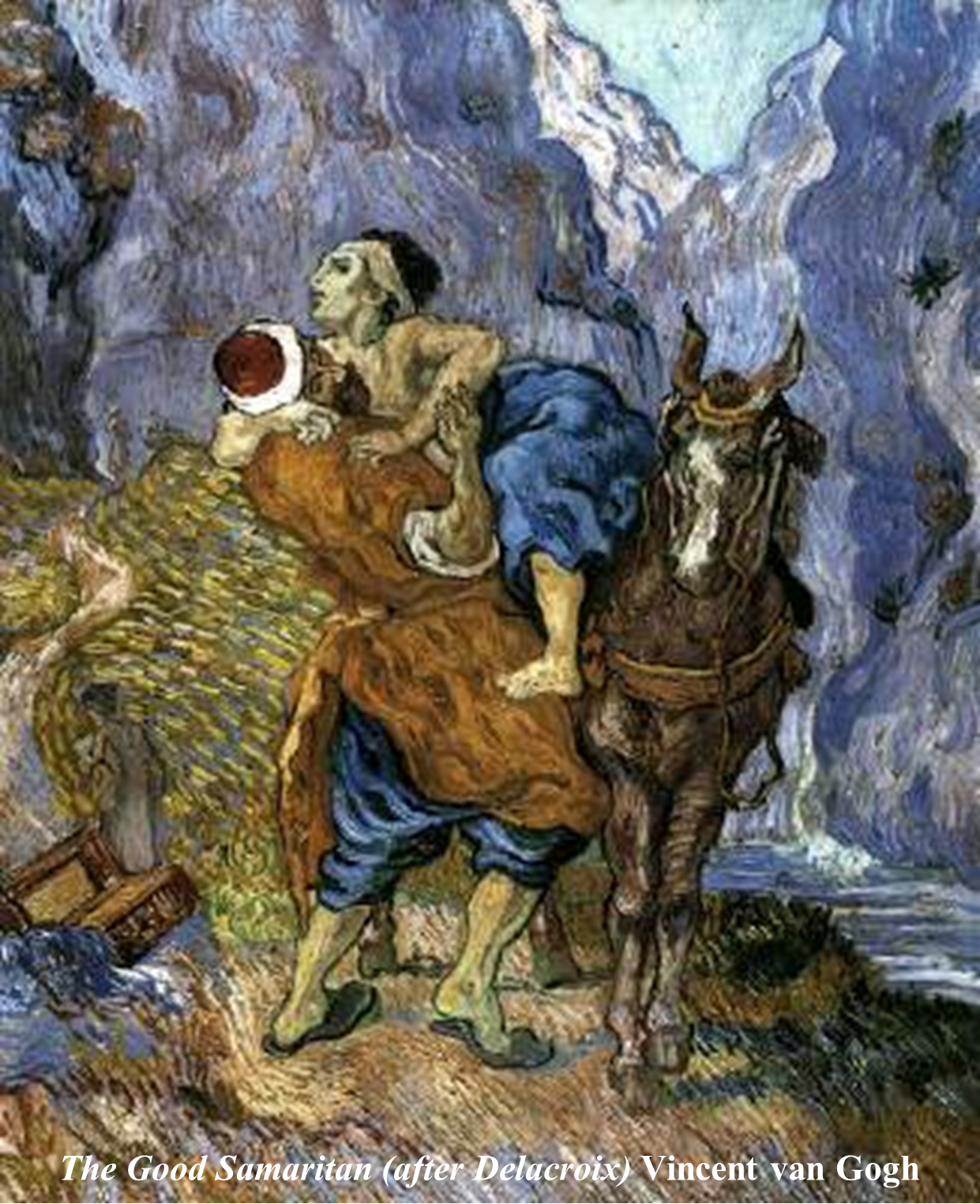
By every measure he came out on top.  He was a leader esteemed by his peers and revered by those who served under him.  A warrior whose acumen on the battlefield provoked fear in his enemies; a commander of distinction whose unswerving loyalty had earned him the trust of his king.  But in spite of all the accolades, there was one weakness he could not hide: Naaman was afflicted with leprosy. And this undeniable fact—this highly visible disease over which he had no control—threat­ened to define his life.

Leprosy and other skin maladies, in ancient as well as modern times, have long stuck fear in the hearts of those who’ve contracted them, and their families. A colleague of mine, who once served a parish on the Hawaiian island of Molokai, spoke of the history of the community of Kalaupapa, which for a century served as a colony for people with leprosy—or Hansen’s disease as we now call it. Despite the advent of new and effective treatments, he said social prejudices continued to prevail. During his tenure at Kalaupapa, church groups who came to the island to work on service projects invariably left something behind when they departed. In the dorm where they had stayed he’d invariably find a garbage sack.  Its contents?  All the clothing they’d used while they were on the island. 

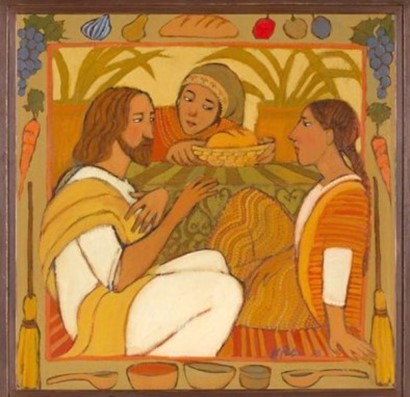
It takes a great deal of effort—internal commitment combined with outward practice—to move beyond the baked-in assumptions and prejudices that are run through our veins and run through our world today and, to a greater or lesser degree, always have.  But that journey can begin with a simple step.  That’s the premise of the POTLUCK PROJECT, the brainchild of Paths to Understanding, an organization led by Pastor Terry Kyllo committed to bridging bias and building community through multifaith peace keeping.  The Potluck Project builds upon a model of community-making that Jesus himself used throughout his ministry: gathering with diverse people for a shared meal.  It was at these meals that Jesus taught about the Kin-dom of God.  It was at these meals that he challenged religious leaders not to allow MERCY to be trumped by concerns about PURITY.  It was at these meals that he coached his apprentices with stories, preparing them to carry on with his mission after he was gone.  His words, “DO THIS TO REMEMBER ME,” apply not only to the institution of the Lord’s Supper—they apply to the modus operandi Jesus used to engage the world.

Over the past year I’ve been cultivating the opportunity for our congregation to join the Potluck Project. Now, at last, the first concrete steps are in place and I invite you to be part of them.  Rabbi Allison Flash of the Kol HaNeshamah Synagogue and I are committed to bringing our communities together using the model developed by Paths to Understanding, and we now have TWO DATES ON THE CALENDAR: Sunday, Sept. 14, 5:30-7:30, and Sunday, Feb. 1st, 5:30-7:30pm.  Please mark your calendars and plan to be part of this important movement!  These planned events are the beginning of what we hope will be an expanding opportunity to bring diverse neighbors together—including folks of other faith traditions or none.  I am looking for people to join a planning team for these events, which we hope to extend beyond the first two initial gatherings.  If you are open to being part of such a team, please let me know.

Last week Marcia Olson and I paid a visit to Fatima Adam, a staff member of Hope Academy, a charter school serving Muslim children that is housed on the property formerly belonging to St. James Lutheran in White Center.  Fatima, along with her sister Asia, who I met with earlier this year, have been eager to learn about the history of St. James church and its commitment to serving the larger White Center community.  It was great to have Marcia along to share some of that history.  At the end of our time together, Fatima said something that has stuck with me: “There is a story God is telling here,” she said.  “You were part of that story.  Now we are part of it.  We don’t know long we’ll be here, but we know that God’s story will continue.” 
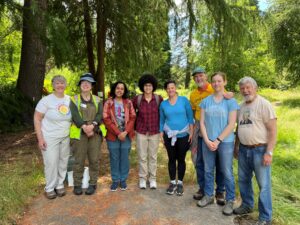
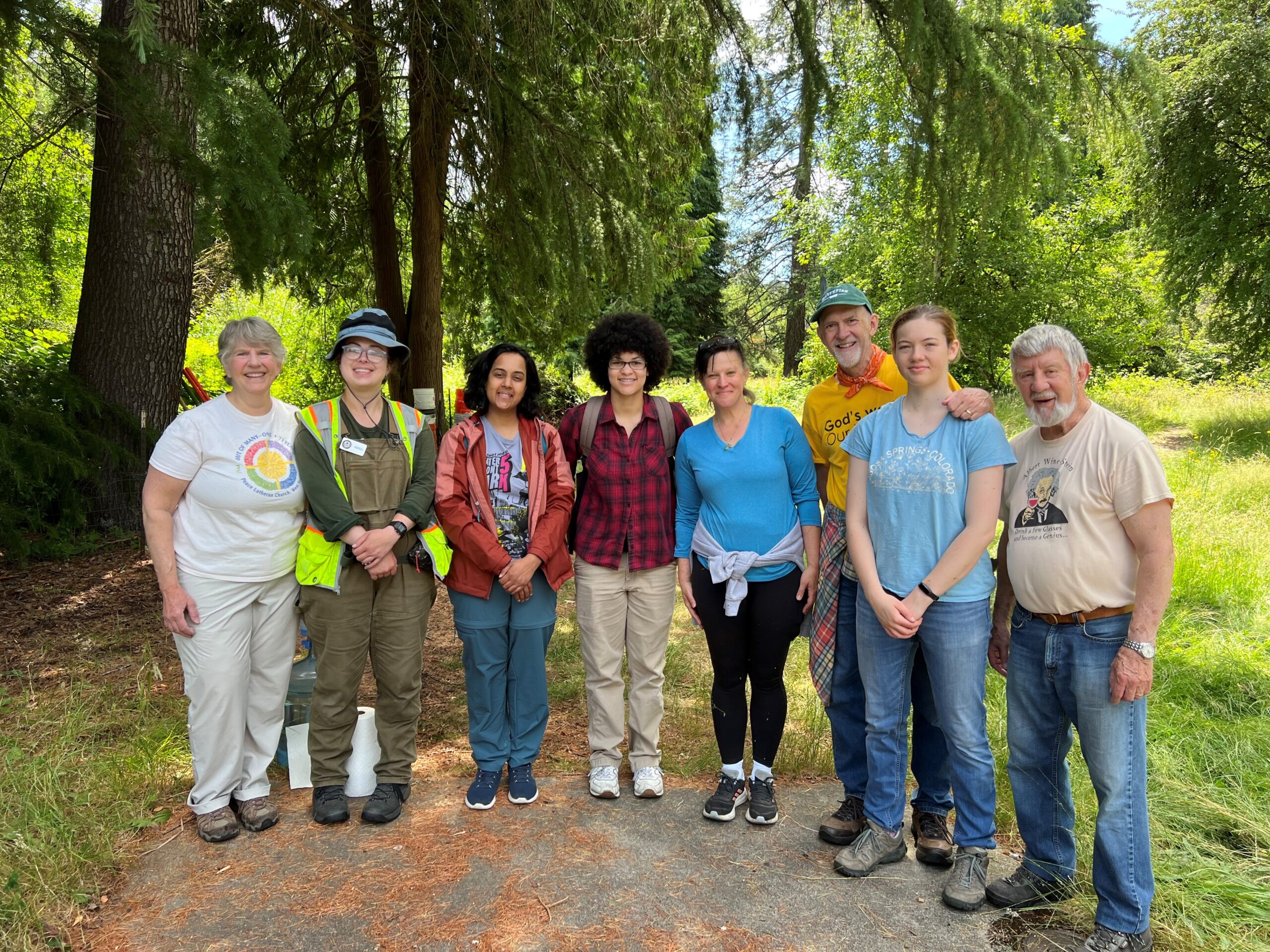
On Saturday, June 28, a crew of us joined Dirt Corps staff for a “God’s Work—Our Hands” event in the Longfellow Creek watershed.  Adrian, our guide, shared her knowledge about caring for trees during the hot summer, including mulching, and then we loaded buckets and wheelbarrows to put the theory into practice.  Over the course of those three hours one of the new friends I met was Aditi, an engineer working for a Seattle based company who recently moved here from her home in Bangalore, India.  As we spread mulch with our rakes in a copse of cedar trees, we fell into a conversation about water, watersheds, and how water plays such a huge role in both Christian and Hindu spiritual traditions.  It felt as if our conversation could go on for hours.  I told Aditi about how our congregation has focused energy on water stewardship; about our Season of Creation—connecting the dots between our lives of faith and the natural world; I mentioned Camp Lutherwood, where the summer theme is WATER OF LIFE; and I told her about the Potluck Project and its goal of bringing people of diverse traditions together for genuine encounters as human beings.  Our serendipitous encounter had the aroma of the Spirit about it.  My fervent hope is that future Potluck Project gatherings will include people like Aditi, along with Muslim and Jewish community members and other neighbors for an encounter full of discovery and common ground.

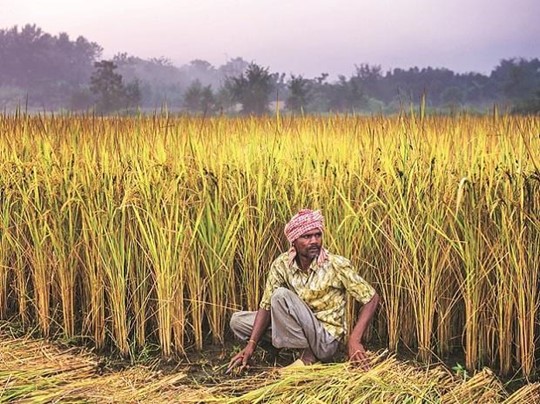
When Naaman the Syrian–at the advice not of his king but rather of his wife’s servant girl–crossed into enemy territory to seek healing from the prophet Elisha, he entered both literally and figuratively into a watershed moment.  Initially reluctant, he finally agreed to follow the order Elisha had given and washed in the Jordan River seven times.  And rising from the river the final time he looked at himself and saw that his skin was restored.  So deeply moved was Naaman that he insisted on bringing two donkey loads of soil from Jordan’s watershed back home with him so that he would remain forever connected to the place where his healing took place.  Naaman’s encounter with Elisha, and the watershed of Grace his experienced, changed his life forever. 

What is the antidote to all the efforts in our country being aimed toward instilling fear, dividing communities, sending people into exile, and limit­ing basic human rights?  Surely the antidote isn’t another slew of Instagram posts or Facebook rants. The antidote, I believe, begins with ordinary people gathering physically around a shared meal, learning one another’s stories and listening for clues about the larger story that God is telling.  A story of healing, of mercy, of peace.

With you on the Way,

Pastor Erik 

 

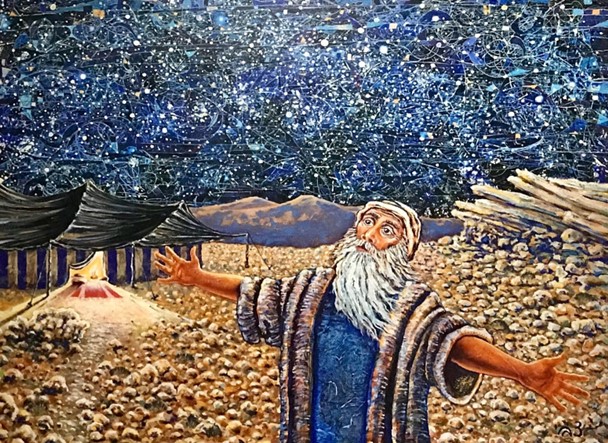
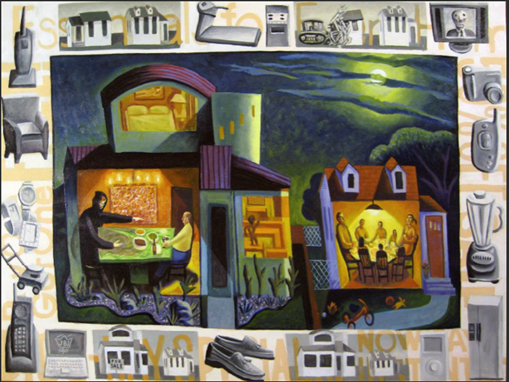
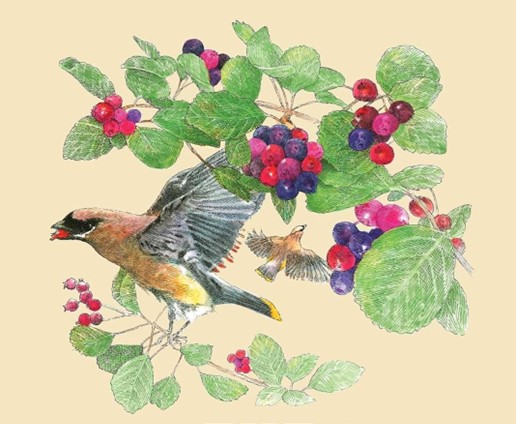
Art by John Burgoyne, used by permission.

Welcome to Peace!  We’re so glad you found us. Worship begins @ 9:30am.

Once more the Season of Creation is upon us.  Our themes for this year’s three week celebration are inspired by Robin Wall Kimmerer’s marvelous little book—The Serviceberry: Abundance and Reciprocity in the Natural World.  

We’ve crafted a liturgy and themes that will both inspire and challenge us over three Sundays, June 15, 22, and 29. Our Week Three theme is Abundant Endowment.

“Materials move through ecosystems in a circular economy and are constantly transformed. Abundance is created by recycling, by reciprocity. Abundance is fueled by constantly circulating materials, not wasting them.”

To join worship via our Live Stream channel, follow this LINK @ 9:30am.

The Worship Guide can be downloaded here: Creation 3C Serviceberry 6.29.25 bulletin FINAL

Art by John Burgoyne, used by permission.

Welcome to Peace!  We’re so glad you found us. Worship begins @ 9:30am.

Once more the Season of Creation is upon us.  Our themes for this year’s three week celebration are inspired by Robin Wall Kimmerer’s marvelous little book—The Serviceberry: Abundance and Reciprocity in the Natural World.  

We’ve crafted a liturgy and themes that will both inspire and challenge us over three Sundays, June 15, 22, and 29. Our Week Two theme is The Myth of Scarcity.

“One of the assumptions of modern economic theory is that we will each behave…as greedy, isolated individuals acting purely in self-interest…But each of us knows that exceptions to this behavior far outnumber the predicted stereotype.” ~  Robin Wall Kimmerer ~

Our Pass the Hat Partner this month is Earth Ministry. Today Scott Menzies, Advocacy Manager, will be with us to give us an update.

To join worship via our Live Stream channel, follow this LINK @ 9:30am.

The Worship Guide can be downloaded here: Creation 2C Serviceberry 6.22.25 bulletin FINAL

Art by John Burgoyne, used by permission.

Welcome to Peace!  We’re so glad you found us. Worship begins @ 9:30am.

Once more the Season of Creation is upon us.  Our themes for this year’s three week celebration are inspired by Robin Wall Kimmerer’s marvelous little book—The Serviceberry: Abundance and Reciprocity in the Natural World.  

We’ve crafted a liturgy and themes that will both inspire and challenge us over three Sundays, June 15, 22, and 29. Our Week One theme is Nature’s Gift Economy. Special music by piano and violin duo Janet Cruse and Jim Hunt will be featured throughout the service.

If you’re coming In-Person, you are invited to bring a gift from nature with you to worship.  For example, you might bring flowers, fruit, herbs, a rock, some honey, vegetables, or some other item.  During the processional hymn you’ll be invited forward to place your contribution in front of the altar/table. [NOTE:  Baskets will be available in the narthex as needed to facilitate multiple gift items.  Any fresh edibles that are received will be donated to the White Center Food Bank.]

In addition to being Father’s Day, Sunday is the beginning of Pollinator Week—a celebration of the vital role that pollinators play in our ecosystems, economies, and agriculture.  Following worship, come to the westside patio to grab a coffee hour treat and learn from Peace member Michael Truog about housing native mason bees.

To join worship via our Live Stream channel, follow this LINK @ 9:30am.

The Worship Guide can be downloaded here: Creation 1C Serviceberry 6.15.25 bulletin FINAL

Welcome to Peace!  We’re glad you found us.

Pentecost is a day of promises fulfilled. The promised Spirit of God is poured out. The baptized have become “children of God” and “joint heirs with Christ.”

On this joyous day, seven young people of our congregation will make public profession of their faith and affirm their baptisms: Luna Churchill, Wyatt Gray, Esme Klinemeier, Kimberly Simmons, Mateo Leon Stephens, Jaxson Troupe, and Ben Ward. A reception will be held in the fellowship hall downstairs following worship.

To join our Live Stream broadcast of this service, click HERE.  

The Worship Guide can be downloaded here: Pentecost 0C Confirmation 6.8.25 bulletin

When you send forth your Spirit, we are renewed!  We are renewed!  – Psalm 104

Children of the Spirit!

It’s easy to be discouraged when we get caught in a pattern of “doom scrolling” through the 24/7 news cycle, shaking our heads at the latest political news and finding our limbic brain hijacked by what we see and read there.  For political party strategists of every stripe, “reactionary mode” is exactly where they’d like us to stay—at least long enough to motivate us to “click” the donation button before we move on.  I’m trying to limit my intake of news beyond a certain time each day, lest my dream life assume the same “gloom and doom” character that dominates our civic landscape. 

As we get ready to celebrate Pentecost Sunday, I wonder if our ancestors in the faith might have something to teach us about how to deal with all the eruptions and disruptions we experience around us?  After all, the first generation of Jewish Christians lived with all the hard realities of Empire.  It was not an easy existence with the ever present threat of violence hanging in the air, the crushing weight of Roman taxes, the uncertainty about the future, the contempt for both their Jewish roots and their emerging faith centered in Jesus as Messiah.  He, their teacher and now risen Lord, had offered them a Way to be in the world; a Way that did not look to the Empire for authentication but was rather an antidote to Empirical might; a Way that welcomed and included those who were sidelined, devalued, and disenfranchised; a Way that opened the door to community with others—including (most radically) non-Jewish neighbors. 

In Luke’s gospel the risen Christ spends 40 days among the disciple community preparing them for what comes next— the outpouring of the promised Holy Spirit.  During those days Jesus teaches them why everything he told them while he was with them had to be fulfilled…his suffering, his death, his rising.  All of it was a prelude so that the life-changing message and power of forgiveness would be poised to make its way around the world.  “You-all are the first to hear it, the first to see it, and you’ll be the first to tell it,” he told them.  “I’ve chosen you to be my witnesses, in Jerusalem, Judea, Samaria, and to the ends of the earth.” (Definitely a commencement vibe to his speech, don’t you agree?)

The overriding spirit characterizing his waiting community was that of JOY.  In the midst of all the challenges they faced, all the demands of Empire, all their existential struggles, they refused to be DIS-couraged—for their risen Lord was in their midst—first in the flesh and now through the Spirit.  I think it’s time for us to seize that JOY and claim it for ourselves!


Pollinator Week Kicks Off Season of Creation June 15th

Come Learn About Supporting Mason Bees in our home gardens

Speaker Michael with one of his mason bee houses.

Come hear Michael Truog talk about providing housing for native mason bees June 15th  after worship on the Peace Patio.

As we enter our Season of Creation this month, we also honor Pollinator Week, a celebration of the vital role that pollinators play in our ecosystems, economies, and agriculture. This year’s theme is “Pollinators Weave Connections,” a reflection on the interconnectedness of our world. It’s a lovely parallel to our focus for this Season of Creation—Robin Wall Kimmerer’s inspiring book, The Serviceberry: Abundance and Reciprocity in the Natural World.

The serviceberry, one of the earliest spring bloomers, is an essential food source for pollinators. Its shallow white flowers, rich with nectar and pollen, are followed by berries and eventually seeds, both feeding dozens of bird species. Among the pollinators drawn to serviceberry flowers are native Mason Bees, who are extremely effective pollinators thanks to how they coat their tiny bodies with pollen.

Bees, butterflies, moths, bats, beetles, and hummingbirds are essential creatures, responsible for one out of every three bites of food we eat, according to the USDA. But many pollinator populations are in decline mostly due to lost feeding and nesting habitats. Pollution, the misuse of chemicals, disease, and changes in climatic patterns are all contributing to shrinking and shifting pollinator populations.

Which is why we have the Peace Pollinator Project! We’ve talked and written frequently about how we can all help these little superheroes by adding native plants to our gardens, eliminating pesticides and weed killers, and “leaving the leaves” come fall. This year, we’re focusing on how we can help native Mason Bees, beginning with a talk from Michael Truog about his experience providing housing for mason bees.

“I’ve been housing Mason bees for a few years now, they are super magical and effective at pollinating,” says Michael. “They are super gentle (they don’t sting anyone) and are easy to manage.”

Later this year, we’ll talk about how leaving your garden a bit messy in the fall protects nesting bees and, during the winter, we’ll build some mason bee houses. Meanwhile, go visit the four Serviceberry trees lining our 39th Ave. SW sidewalk!

— Deb Hagen-Lukens for Creation Care


More information about Creation Care at Peace Lutheran Church:

Welcome to Peace!  We’re glad you found us.

In today’s readings the risen Christ ascends into heaven and his followers are assured that the Spirit will empower them to be witnesses throughout the earth. The disciples are told to not gaze up into heaven to look for Jesus (Acts1:11); we find his presence among us as we proclaim the word and share the Easter feast. We, too, long for the Spirit to enliven our faith and invigorate our mission.

Today is scholarship Sunday at Peace and graduating seniors Jesse Dabbs and Vinh Le-Truog will each receive a $1,500 Peace Scholarship.  The purpose of the Peace Scholar­ship is to offer support to high school graduates from Peace and who develop a plan to further their education and/or prepare themselves for lives of service in the world.  The scholar­ship is a tangible gesture of our congregation’s investment in them as per­sons, our enduring interest in their lives, and our conviction that God de­sires to use them as “salt and light” in the world.

To join our Live Stream broadcast of this service, click HERE.  

The Worship Guide can be downloaded here: Easter 7C 6.1.25 bulletin FINAL

 
   Peace Lutheran Church has received two cemetery plots as a donation. 
   They are on offer to congregation members to consider for their estate planning. 
 
    Each property may memorialize one or two persons. 
 
   Memorials may be in three possible forms: 
      a. Interment of a casket and/or 
      b. Interment of an urn, and/or 
      c. Cenotaph memorial for someone whose remains will not be interred.
 
    Each property is valued at about $10K with fees 
    Each property may memorialize a veteran or a veteran’s spouse (current or former) as primary memorial. 
    Each property may also memorialize a second person – a spouse, parent, child or sibling of the primary memorial.
 
    Location: Veterans Section, Lot 45, Block D, spaces 3 and 4 of the Washington Memorial Park in SeaTac, WA (managed by Bonney-Watson)
 

Photo of the Veterans section of Washington Memorial Park Cemetery, taken May 29, 2021