
Archive for the ‘Archive’ Category

Holy TrinityWelcome to Peace – we’re glad you found us!

On Trinity Sunday we celebrate the mystery of the Triune God: Three-in-One. When we say God is the triune God, we are saying something about who God is beyond, before, and after the universe: that there is community within God.  This God whom we worship invites us to join this dance of community and shows us what mutual giving, receiving, and joy looks like.  The circle of Trinity is not a closed circle: All creation is invited in.  Our guest preacher is Rev. Terry Teigen, who will be preaching on the texts from Isaiah and John.

It  is also Scholarship Sunday at Peace and West Seattle High grad Phoebe Sunde is our Peace Scholar this year.  Our Live Stream service can be found HERE.

The worship guide can be found here: Pentecost 1B 2021 5.30.21 livestream bulletin

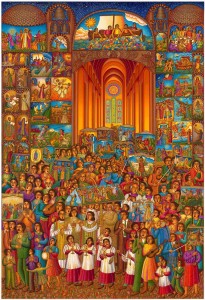
Pentecost, John August Swanson (c) 2013

Pentecost, John August Swanson (c) 2013

Welcome to Peace – We’re Glad You Found Us!

On Pentecost Sunday we celebrated the outpouring of the promised Spirit on God’s people.  This promise of God’s indwelling presence on earth among us revives HOPE and brings dry bones back to life.

You can find our YOUTUBE RECORDING HERE. The worship guide can be found here: Pentecost 0B 2021 5.23.21 livestream bulletin

Picture1Welcome to Peace – We’re glad you found us!

In today’s Ascension Sunday readings the risen Christ ascends to the heavens and his followers are assured that the Spirit will empower them to be witnesses throughout the earth.  Like the disciples, we too long for the Spirit to enliven our faith and invigorate our mission.

PASS THE HAT PARTNER: COVID RELIEF FUND + LUTH. DISASTER RESPONSE

Today is Pass the Hat Sunday. We welcome Bishop Shelley Bryan Wee to tell us about the Synod Assembly offering split: between the COVID-19 Relief Fund and Lutheran Disaster Response.  In early 2020 the COVID-19 Relief Fund was established in the NW Washington Synod to provide financial relief for congregations and ministries. This fund has continued to grow through individual and congregation donations as well as grants provided by the ELCA for COVID-19 Relief.  

Lutheran Disaster Response brings God’s hope, healing and renewal to people whose lives have been disrupted by disasters in the United States and around the world. When the dust settles and the headlines change, we stay to provide ongoing assistance to those in need.  One current focus is the unfolding COVID-19 disaster in India. (See more on the announcement page.) Follow the above links if you would like to share a gift.

You can find this live stream service on our YouTube Channel.

A copy of the worship guide can be found HERE: Easter 7B 2021 5.16.21 livestream bulletin

Picture1Welcome to Peace – We’re glad you found us!

Happy Mother’s Day to all those women who mother children, embodied reflections of our “Mothering God” who brought the universe, the Earth, and our selves to birth.

On this 6th Sunday of Easter we hear Jesus’ commandment to exercise loving friendship with one another.  “No one has greater love than this, to lay down one’s life for one’s friends. You are my friends if you do what I command you.”

You can find this live stream service on our YouTube Channel.

A copy of the worship guide can be found HERE: Easter 6B 2021 5.9.21 livestream bulletin

Picture1Welcome to Peace – We’re glad you found us!

Today, as we witness the confluence of biography and faith wrapped up in the encounter between Philip and the Ethiopian Eunuch, and as we hear Jesus tell us we are branches connected to the Vine, we ask the questions:  Where do stories begin?  And where do they end?

Jesus reminds us that our stories abide in the Vine, and are part of God’s great salvation story which enfolds all things.

You can find this live stream service on our YouTube Channel.

A copy of the worship guide can be found HERE: Easter 5B 2021 5.2.21 livestream bulletin

“Beloved, let us love one another, because love is from God; everyone who loves is born of God and knows God.  Whoever does not love does not know God, for God is love.  God’s love was revealed among us in this way: God sent his only Son into the world so that we might live through him.”

– 1 John 4:7-9

Beloved of God,

Over and over again in the first of his three new testament letters, the Apostle John holds up the many-faceted diamond which is God’s love and describes it—and our relationship to it—in various ways.  Addressing the community as his “Little children,” John speaks in fatherly tones both tender and strong about our calling to live our lives in the Light and Love of God.  “God is love,” he writes, “and those who abide in love abide in God, and God abides in them…There is no fear in love, but perfect love casts out fear.”  His words are simple, direct, and true.  This the bedrock foundation of our lives of faith—trusting that God’s love is FOR US; trusting that we are children of God; trusting that God’s deepest desire and dream for us and for all is that we live our lives steeped—marinated—in this truth, and embody it in our life together!

In the second century milieu in which John writes, gnostic teachers vied among Christians for converts to their cause.  Gnostic claims to perfection, denial of the significance of Jesus’ coming in the flesh, rejection of the saving power of Jesus’ death, and divisive preaching were all part of the gnostic teaching strategy.  John writes to keep his community grounded amid the competing claims of Gnosticism.  He writes to remind them of what is central; to help them regain their balance.

“By this we may be sure that we are in him: whoever says, ‘I abide in him,’ ought to walk just as he walked…whoever says, ‘I am in the light,’ while hating a brother or sister, is still in the darkness.”

In our own lives, as throughout the long history of human relationships, we regularly lose sight of this crucial revelation and its implications.  Secondary commitments flood in from every quarter and push what should be central out to the periphery.  LOVE—whose rightful place is at the center; LOVE—which is meant to take on flesh in our lives—is replaced by something else, and we start making distinctions about who is love-worthy, who deserves our—and God’s—love.  When love is displaced, fear and judgment soon take its place.  And it’s all downhill from there.  As Jesus said to his disciples:

“It shall not be so among you.” (Mt. 20:26)

One of the commitments our congregation made in 2008 was to be a Reconciling in Christ congregation, i.e. publicly welcoming LGBTQ persons into the life and mission of the church.  The welcome statement we approved reads:

Christ calls us to reconciliation and wholeness, in a world that can be filled with alienation and brokenness.  In faithfulness to the Gospel and to our Lutheran heritage, we answer Christ’s call to be agents of healing and safety, particularly for people who have been marginalized by our society. As a Christian community, we invite all people to join us as we work to better understand the meaning of grace for our lives.  We welcome people of all sexual orientations and gender identities into the life and mission of our congregation. – PLC welcome statement

In recent decades—and particularly over the past several years—awareness has been  growing among some within the highest caste (i.e. among white folk) regarding how the historic CASTE system in our country has embedded inequality and injustice within American culture, as manifested in the systemic racism and white supremism that plagues us. Over the past few years in our adult Sunday forum group we have sought to educate ourselves about the attributes that accompany whiteness, about the experience of people of color in our society, and about the power that systemic racism exerts within our lives and communities.  Now we are called to take the next step of embodying what we have learned, integrating it into our identity and mission.  Not taking that step is not an option.  For, as John writes, “Those who say, ‘I love God,’ and hate their brothers or sisters, are liars; for those who do not love a brother or sister whom they have seen, cannot love God whom they have not seen.  The commandment we have from God is this: those who love God must love their brothers and sisters also.”[1]

Reconciling Works, the organization that helps to advocate and equip congregations for ministry particularly with LGBTQ community, has made a new commitment as an organization to racial equity, and they have invited us, as a Reconciling in Christ Congregation, to join them. This commitment on the part of Reconciling Works has implications for the way we, as a congregation, move forward.  We are being invited to enter into specific commitment to justice and inclusion, in this case, naming our commitment to racial equity and/or antiracism within a revised welcome statement.  (The framing of this commitment can be found HERE.)  The question now before us is: How can we take the next step of translating what we’re learning into action?  The time has come to gather a group of people from among us who will lead our congregation in exploring and enacting the invitations delineated by Reconciling Works, and the Task Force for Authentic Diversity.  I am looking for partners who feel called to participate and help guide this effort within our congregation.  Please let me know if you are one of those persons.

With you on the Way,

Pastor Erik


[1] 1 John. 4:20-21

Sun with mountain flowersWELCOME TO PEACE ON EARTH SUNDAY!

Come join with Lutheran leaders and voices from around the country in a special service celebrating Earth Sunday by following this LINK.

Today’s service is offered by Lutherans Restoring Creation, a grassroots movement promoting care for creation in the Evangelical Lutheran Church in America (ELCA).  The preacher for this service is Dr. Elizabeth Eaton, presiding Bishop of the ELCA.

A copy of the Worship Guide can be downloaded here: Easter 4B 2021 4.25.21livestream bulletin

Exuberant girls leap for joy at Iona on Easter

Exuberant girls leap for joy at Iona on Easter

CHRIST IS RISEN!  ALLELUIA!

This 3rd Sunday of Easter we welcome Pastor Chelsea Globe, Lutheran Campus Minister at the University of Washington, to our pulpit.  Lutheran Campus Ministry is our Pass the Hat Partner for the month of April, and you are invited to consider a gift in support of this ministry.

You can find this live stream service for April 18, 2021 on our YouTube Channel.

Incredulity of St. Thomas, Caravaggio (1602)

Incredulity of St. Thomas, Caravaggio (1602)

CHRIST IS RISEN!  ALLELUIA!

This second Sunday of Easter we join congregations from throughout the NW Washington Synod, along with Synod Staff, in worship.  Pastor Andy Yee, assistant to the bishop, is the preacher, with musical and other contributions from across the synod.

You can find the service on our YouTube Channel beginning @ 10:30am Sunday.

A PDF copy of the Service Guide can be downloaded here: Easter 2B 2021 4.11.21 livestream bulletin

Easter service graphic


Make no mistake: if He rose at all
it was as His body;
if the cells’ dissolution did not reverse, the molecules
reknit, the amino acids rekindle,
the Church will fall.

It was not as the flowers,
each soft Spring recurrent;
it was not as His Spirit in the mouths and fuddled
eyes of the eleven apostles;
it was as His flesh: ours.

The same hinged thumbs and toes,
the same valved heart
that–pierced–died, withered, paused, and then
regathered out of enduring Might
new strength to enclose.

Let us not mock God with metaphor,
analogy, sidestepping, transcendence;
making of the event a parable, a sign painted in the
faded credulity of earlier ages:
let us walk through the door.

– Seven Stanzas at Easter (excerpt), John Updike[1]

Dear Easter People,

Christ is risen, Alleluia!  I often experience a “spring” in my step when walking on this side of Easter. Though our journey from a Lenten to an Easter sensibility may proceed more slowly due to the pandemic that still holds sway over much of the world, we are, nonetheless, called to live as Easter people; called to embody resurrection hope in our lives, and put it on display in tangible ways.  After all, Easter is not a single day on the calendar—or even a season—it is a way of life!

In a recent article, Peter Marty tells how his maternal grandmother died suddenly at age 40, leaving behind a bereaved husband and an eight-year-old daughter (Peter’s mother.)  His grandfather, a Lutheran pastor, struggled to move beyond the grief that crippled him.  Every Sunday afternoon for years, he would make his daughter accompany him to the cemetery to visit the grave.  “This weekly ritual,” Marty writes, “cast such a pall over my mother’s young life that it essentially blocked every other memory of her childhood.”  He goes on: “Something in me wishes that a gravedigger would have walked up to him one Sunday at Cave Hill, interrupted his mourning, and said straight to his face, ‘You know, you really need to go and do something else with your Sundays. Good years are still ahead of you and your daughter.  Go and make something of your life that’s not going to happen here.  I’ll take care of the grave.’”[2]

Once, in the crypt at Christchurch Cathedral in Dublin (where post-worship coffee hour is held!), I saw something fascinating—if a bit bizarre: The mummified remains of a cat and a rat encased in glass.  The sign told how the cat, (presumably chasing the rat), became stuck with its prey in a Cathedral organ pipe 150 years ago.  As a result, both were mummified.  The moral of the story?  Those places we become stuck in life will become our graves if we’re not careful.

The fears, regrets, and failures that cling so closely to us can make forward movement seem impossible, locking us in a perpetual struggle from which we cannot extricate ourselves; leading us to doubt God’s presence or even existence.

All of these elements were present in the graveyard Peter Marty’s mother and grandfather visited weekly—and they were present, too, in the graveyard outside of Jerusalem where the women went to tend the body of their crucified Lord. But on this trip to the graveyard, something new, something unpredictable took place—the stone was rolled away; the tomb was empty.  Jesus had been raised.  Later that night, St. John tells us, the resurrected Christ made his first appearance to his fearful community, showing them his wounded hands and side and blessing them with peace.  But even after that physical and spiritual encounter, the adjustment of Jesus’ apprentices to the new Easter reality didn’t happen overnight.  It took years before Jesus’ disciples could put into words what they experienced and what it meant.

What does this mean for us?  It means we have time.  Time to discern specifically how the resurrected Christ might manifest himself in our individual lives and in the life of our community.  Time to put our faith into practice on a daily basis, reaching beyond the fear, the loss, and the uncertainty that perpetually seeks to hold us captive.

No imagined resurrection can set us free from fears that crouch so closely, so craftily in the midst of our lives; no metaphorical resurrection can get us unstuck from the pervasive struggles that come with the territory of being human—only a bodily one can.  “Make no mistake,” writes Updike, “if He rose at all, it was as His body…”  Only the resurrection could turn cowardly Peter into a powerful preacher; could transform the persecutor Saul into the missionary Paul.  Only the resurrection could turn ordinary women and men into saints and martyrs, preachers and prophets, activists and organizers intent on building bridges rather than walls, and in the process rising from the margins to become a living, breathing, vibrant community with people of every tribe and race, tongue and nation.[3]

As this Easter season enfolds we’ll be tracking both the growing percentage of vaccinations given and the proliferation of new virus strains.  We’ll be developing scenarios for what a return to in-person worship might look like.  We’ll be adjusting to children returning to school in hybrid models and bracing ourselves for how this return will affect our household schedules.  As we engage these matters, let’s do so with a commitment to not getting stuck; let’s do so with a spirit of hopeful expectation.  For Christ is risen indeed! Alleluia!

Pastor Erik

[1] John Updike, “Seven Stanzas at Easter,” from Telephone Poles and Other Poems.  New York: Alfred A. Knopf, 1959.  Published in Bread and Wine: Readings for Lent and Easter.  Maryknoll, NY: Orbis, 2003, p. 261.

[2] Peter Marty, Christian Century.  Find his full article here: https://www.christiancentury.org/article/living-word/april-4-easter-day-b-mark-161-8

[3] Shawnthea Monroe, The Word , March 16, 2016 edition of Christian Century.