
Archive for the ‘Pastor’s Pen’ Category

“The LORD told Abram ‘GO’… And Abram went.”

– Genesis 12

Beloved of God,

Summertime has always been, for me, a time when I look forward to traveling; a time for entering new spaces and rhythms in family and congregational life; a time for visiting new and familiar landscapes and coming home renewed.   Last year at this time our family was re-entering life in the Northwest after having been on sabbatical.  We’ve been playing the “where were we a year ago?” game for the past four months, and it’s enabled us to recapture some of the experiences we shared along the way and to keep alive the prospect of returning “someday” to places and people we came to cherish along the way.

When God issues the call to Abram to leave everything he’s known—country, hometown, family—and to go to a new place that God will show him, God promises Abram that through him “all the families of the earth will be blessed.” (Gen. 12:3)  In response to this call, “Abram went.”  Historian Thomas Cahill calls these two words “two of the boldest words in all literature” for they signal a complete departure form everything that has gone before in the long evolution of culture and sensibility.  “Out of ancient humanity,” writes Cahill “comes a party traveling by no known compass.  Out of the human race…comes a leader who says he has been given an impossible promise. Out of mortal imagination comes a dream of something new, something better, something yet to happen, something—in the future.”[1]  What’s being midwifed in this encounter, according to Cahill, as a whole new concept—the concept that what lies ahead us could be different from what we’ve known before; the concept of FUTURE.

These days we take the FUTURE for granted. That is, we take the idea that tomorrow could be different than today —and different in significant ways and better ways—for granted.  The recent Great Recession, the acceleration of Climate change, and the continuing specter of terrorism may have put a chink in that armor, but by and large we (at least I) carry in my head the notion that the future is not predetermined or just a rerun of the past, but can be different; that I can change, that circumstances can improve, that the world can be better. 

Theologically speaking, Lutherans have held a dim view of the human capacity to change.  The mystery of the cross lies at the very heart of our way of seeing God at work in the world, suffering and dying and coming face to face with all that is wrong with human existence.  “We are in bondage to sin and cannot free ourselves,” we confess!  Yet Christ’s crucifixion is not the final act or word.  God’s final word is RESURRECTION, and it is not only a word, it is an ACT as well as a PROMISE.  What drives my conviction that my future and the world’s future can be different is my faith in the resurrection of Jesus.  On Easter morning we learn that God has something more planned for us and this world than a trajectory that ends in the graveyard.  We have a future “hidden in God,” a “better country” to look forward to; one that begins now and will reach its full embodiment when God deems it time.  Our job is to trust that truth and to live into it.  This resurrection faith gets affirmed in profound ways when I have the privilege of accompanying people of faith as they prepare to cross from this life to the next.

As I write to you, the recent death of our brother in Christ Al Drackert on June 29th is fresh in my mind.  When I last saw Al at his apartment at Daystar the day before he died, he was lying in his bed.  As I leaned over him he looked up at me, opened his eyes, smiled his crooked smile, and said, “Thanks for everything, Pastor.”  Oh, thank YOU, Al.  Later, when Chris arrived with her flute, we sang some of his favorite hymns with the members of his family who were present, and Al hummed along, chiming in “that’s a good one.”  At the edge of death Al was praising and thanking God.

Al knew the meaning of gratitude and found a way to express it on a daily basis.  One of his favorite phrases was “gracious living.”  Whether he was with his friend Bob Gains delivering Meals on Wheels, or passing the peace in worship, or reflecting on life from a hospital bed, he always steered back to that place.  His inner compass was locked on Grace, and because of that his eyes were opened to see blessings blossom all around.  “I am amazed” he would say.   As he prepared to make his final journey from this life to the next, Al seemed fully prepared to relinquish what he’d known here and to place his life with trust in the arms of the God of resurrection, the God who holds the future.  Blessed to be a blessing.

We are all blessed to be a blessing.  God’s promise to Abram is still being worked out in the lives of people of faith across the globe, in your life and mine, as we journey through this life.  Wherever our journeys take us this summer, whether near or far, we all will be given myriad opportunities to bless those we encounter; to pass God’s grace and blessing on. 

Via con Dios – Go with God!

Pastor Erik


[1] Thomas Cahill.  The Gifts of the Jews.  (New York: Anchor Books, 1998) p. 63

“When you send forth your Spirit, we are renewed, we are renewed!” – Psalm 104

Beloved of God,

If you were in worship on Pentecost Sunday (May 24), you participated in a conversation break during the sermon.  The theme for Pentecost Sunday was the Spirit being unleashed on Christ’s disciple community—PUSHING THEM OUT into the public square to engage with others and share the good news of what God was bringing to the world through Jesus.  The first question folks were invited to discuss in small clusters around the sanctuary was: 

What is the chief resource of our congregation?

Your most common response was “the people.”  Many cards had modifiers attached, like “caring people” or “motivated people” or “welcoming people” or “young people.”  Other answers clustered around our building as a resource and how it is used or could be used to help the neighbor.  Still others identified the “welcoming spirit” and “friendliness.”  These answers are not surprising.  The congregational culture of Peace, its “DNA” so to speak, expresses itself in warm and welcoming hospitality.

But it’s not enough to identify what the chief resource of our congregation is; we have to make certain we utilize that resource to connect our congregation to the neighbors and neighborhoods that surround us.  To that end, folks were asked to discuss a second question:

How can we use that resource to connect to the neighbors that surround us?

To this question there were a great variety of responses.  Some of them focused on getting us OUT of the building and interacting with neighbors, or hosting events outside that supported interaction with neighbors.  Some mentioned what we’re already doing and others suggested more fully utilizing music and the arts as a means to interaction.  I hope that conversations around these questions will be ongoing ones for us.  If you have any brainstorms, please jot them down and share them with me or with Bob Wightman, our president—we’d like to hear from you!

The fact is, we are doing much to convey the message that we are a congregation that cares about its neighbors.  Whether it’s hosting Mary’s Place families, supporting local food banks, building Little Libraries, sharing our facility, building raingardens, floating seal rafts, doing biannual landscape projects in the community, serving meals at Compass Center, or going about God’s work with our hands in other ways, I believe we sense the importance of bringing our vision and our energies to birth out in the world.  Surely this is the Spirit’s call!  I believe that this, in part, is why our congregation is bucking the trend of most urban congregations and GROWING in membership rather than SHRINKING.  

The pulsing core of our mission begins in our gatherings around God’s Word, Font and Table.  Without the experience of weekly worship, our batteries run down and our motivation for service suffers.  But our worship life is only the beginning.  Our life of faith never stops here or ends here or stays here.  The Spirit propels us ever outward, just as it propelled the disciple community out of their homes and into the streets.  Wherever the Spirit propels you these coming months, I pray that it will be an enriching and rejuvenating time, and a time when you are able practice your vocation as a bearer of good news in ways that make a difference!

Yours in Christ,

Pastor Erik


“We love because he first loved us.  Those who say, “I love God,’ and hate their brothers or sisters, are liars;
for those who do not love a brother or sister whom they have seen, cannot love God whom they have not seen.”
1 John 4:19-20

Beloved of God,

I can’t say when I first heard of Pastor André Trocmé or the protestant village of Le Chambon-sur-Lignon, but I’ve always been drawn to people of high moral integrity.  So when I heard the story of a village in France that harbored Jewish refugees during WW2 at great risk, I was captivated by it.  When I began planning my sabbatical, Le Chambon emerged as one place I wanted to see firsthand.  I wanted my family to get as close as possible to this story and the people and principles behind it.

At first, I had limited luck in my internet searches for information about whether a museum dedicated to the heroic efforts of the people there existed.  I could only find references to a temporary museum that once existed, or to the dream that a museum might one day be built.  But then I found an article by Dr. Patrick Henry, a retired professor from Whitman College.  His article gave a brief but thorough explanation of the historical context in which this “conspiracy of goodness” took place.  As time before our departure for sabbatical was running short, I tracked down his email address and wrote him, hoping he might respond.   Not only did he write back almost immediately, sharing information that proved immensely helpful as I prepared for our visit to Le Chambon, unbeknownst to me he blind copied Nelle Trocmé Hewitt, the daughter of Pastor André and Magda Trocmé.  Within a few hours of my initial inquiry I found myself corresponding with a woman who not only knew of Le Chambon, she had been at the epicenter of these events as both a witness and participant!  Nelly provided me with information about the newly opened state-of-the-art museum in Le Chambon, Lieu de Mémoire, as well as the names of contacts she knew.  And she urged me to see Pierre Sauvage’s film Weapons of the Spirit, before I left town—which I did.  The entire series of exchanges was a Spirit-inspired gold mine!

On May 3rd you have the opportunity to hear more about this incredible story of neighbor love that took place in Le Chambon and the surrounding farms and villages of the Vivarais Plateau.  Dr. Henry will address the combined Adult and Youth classes from 9:15am to 10:15am.  Then, following worship, we’ll share a simple lunch in the Fellowship Hall, as we view the film Weapons of the Spirit and continue our conversation together.  I hope you’ll come.

“When you send forth your Spirit, we are renewed—we are renewed!” – Psalm 104

Throughout the Easter season we hear stories from the book of Acts which speak to the Spirit-infested power of the gospel life, which spins good news out into the world with untamable, centrifugal force.  Old boundaries fall away in the wake of such a force; and new connections into the community of Jesus abound.  Readings from the letters of John, like the excerpt above, remind us that everything that comes from God is predicated on LOVE. “Those who do not love a brother or sister whom they have seen, cannot love God whom they have not seen,” writes John.  Whatever fears may seek to lay hold of us, skewing or dominating our lives and keeping us curved in on ourselves, says John, as we place our trust in the God revealed to us in Jesus, God’s “perfect love casts out our fear.”  When that happens, the unknown loses its ability to keep us in bondage.  And when this happens, incredible acts follow.

In his memoire, Pastor Trocmé wrote of the important role played by the parish’s Bible study leaders and group meetings: “It was there, and not elsewhere, that answers from God came regarding the complicated problems we had to resolve for the housing and hiding of Jews…It was there that we conceived of non-violent resistance.”1 Through their animated discussion of the Bible and its role in their lives, these groups “saved the situation” in Le Chambon.  They provided opportunities for faithful reflection and the development of strategies for sheltering those fleeing from the German and the French authorities.

The work of the Spirit continues in our own day and context, and our job is to align ourselves—individually and communally—with the Spirit’s mission.   When we keep our hearts, minds, and bodies opened to the Spirit’s breath, we will end up in some surprising places!  That’s the journey we’re on together, as we sing with the Psalmist:

“When you send forth your Spirit, we are renewed—we are renewed!”

With you on the Way,

Pastor Erik

­­­­­­­­­­­­­­­­­­__________________________

1 Alicia J. Batton, University of Sudbury, Ontario. Reading the Bible in Occupied France: Andre Trocmé and Le Chambon. p. 14.  Quoted from A. Trocmé, Autobiographie “André and Magda Trocmé Papers,” copyright Swarthmore College Peace Collection, 1960’s) 357.

Tree of life 2 - Copy

“They put him to death by hanging him on a tree; but God raised him on the third day.”  – Acts 10:39, 40

“The world breaks every one, and afterward, many are strong at the broken places.”

Ernest Hemingway, Farewell to Arms


Dear Easter People!

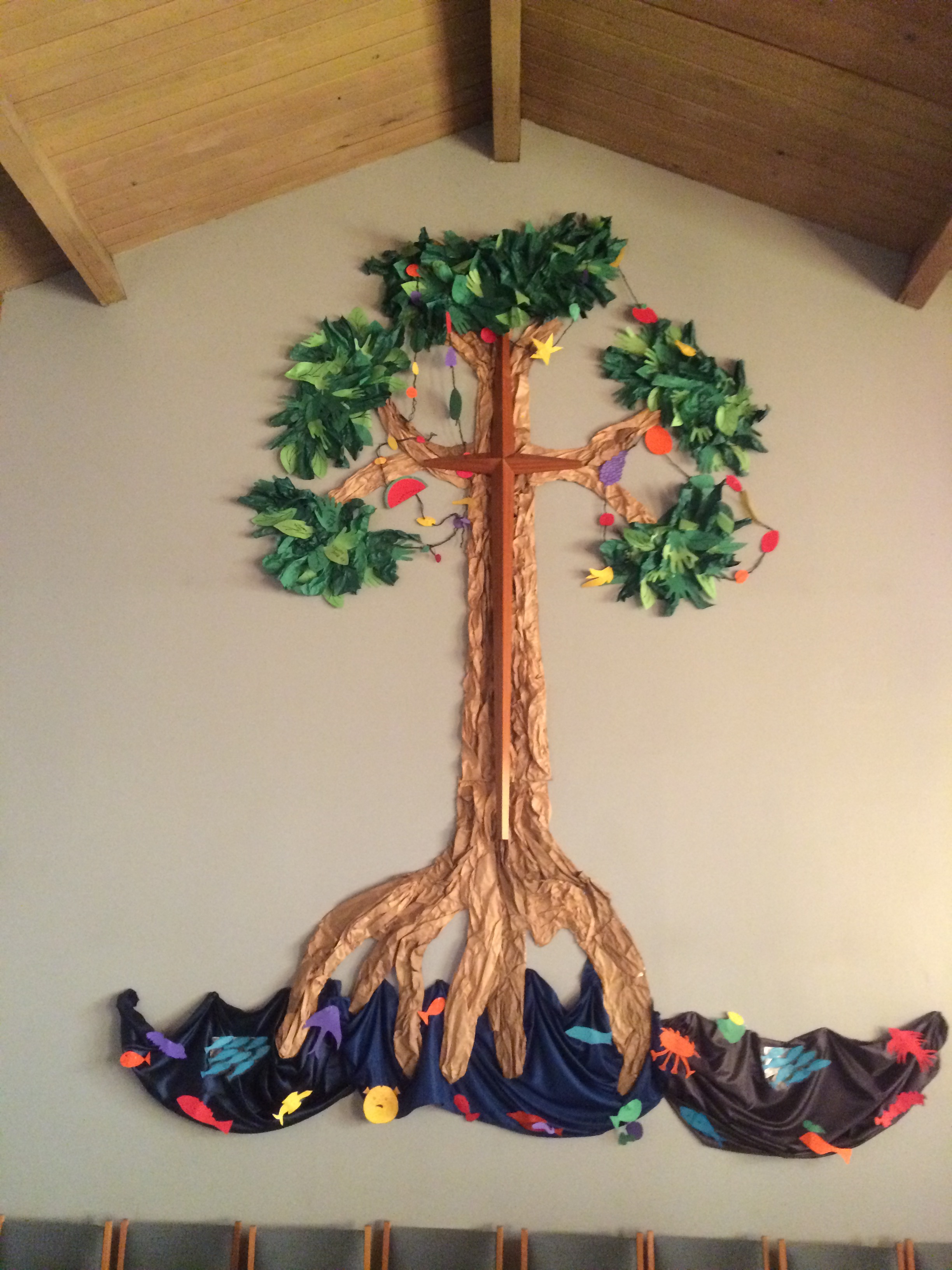
Throughout the Lenten season we have watched as the cross on the east wall of our sanctuary has gradually become the Tree of Life.  God’s act of raising Jesus from the dead transforms what the world forever intends to be the tree of crucifixion into the Tree of Life!  This is the new reality we celebrate on Easter.  The final verdict God pronounces upon us and on all creation is not a sentence of death but rather a sentence of LIFE! 

This doesn’t mean that all the woundings that life inflicts on us magically disappear on Easter—they don’t.  The risen Jesus himself reveals this truth to us.  In his appearance to the disciple community after his resurrection, both in Luke and in John, Jesus shows them his wounds.  His hands, feet, and side still bear the marks of the nails and spear.  And yet, these wounds no longer hold him captive, for they have been healed.  “The world breaks every one,” wrote Hemingway, “and afterward, many are strong at the broken places.”  The resurrection makes all who put their trust in the God of Jesus strong in the broken places.

Recently a colleague introduced me to a centuries-old Japanese art for fixing broken pottery. It’s called kintsugi or “golden joinery”.[1] Instead of discarding broken bowls, plates and vases, this approach to pottery (and to life) celebrates the artifact’s unique history by emphasizing the fractures and breaks instead of hiding or disguising them.  The pottery is bound in its broken places with a special lacquer and then dusted with powdered gold, silver, or platinum.  The result: beautiful seams of gold glint in the cracks of ceramic ware, giving it a truly unique appearance.  It is often the case that this approach to repair makes the repaired piece even more beautiful than the original, revitalizing it with new life.  The art of kintsugi, which dates back more than 500 years, is related to the Japanese philosophy of wabi-sabi: finding beauty in the flawed or imperfect.

Franciscan Richard Rohrer calls imperfection “the organizing principle of the entire human spiritual enterprise.”  St. Francis, says Rohrer, wore patches on the outside of his habit so everyone would know what he was like on the inside.  “Imperfection,” says Rohrer, “is not to be tolerated, marginalized, excused, or contextualized, or even forgiven, it is the framework in which God makes the Godself known and calls us into union.”

As we celebrate the resurrection of Christ, and God’s promise that we, too, will be raised with Christ to new life, we rejoice!  For we now know that the Master Potter who formed us in the beginning will re-form us in all our broken places, repairing the fragile vessels of our lives so that they stand—even now—as emblems of beauty and grace: the broken made whole. 

Alleluia! 

Pastor Erik


Hamba nathi mkululu wethu

Come walk with us, the journey is long.

– Traditional South African Song

People on the Way,

We awoke just before the sun first peaked above Tuscany’s eastern hills and quickly made ready for our journey. 

The forecast called for mid-90 degree weather, and we knew that for each moment the sun shone the temperature would inch upwards.  We left our farm house 6:45 and made it to the town of Gambassi Terme a few minutes after 7. The sign just outside the Church of San Maria a Chianni announced the Via Francigena—our pilgrims’ trail—and after taking a photo to document our beginning, we were off at 7:20am.

The first kilometer descended on twisting tarmac and we had to watch the road and traffic.  It was a relief to leave that behind and to be on a farm road that descended gradually toward the valley below.  A view of San Gimignano in the distance set the goal right before us. The air was still cool, and our spirits high.  “Come walk with us the journey is long…” Naomi and I sang, as the road descended past vineyards and olive groves, enjoying the still and abundant beauty of the vistas, morning bird song, and the joy of the road.  For the first time in weeks I felt that we were pilgrims more than tourists; and my heart grew lighter and fuller even while the temperature rose.

Along the way I talked about Archbishop Sigeric, the newly appointed bishop of Canterbury Cathedral, who made a journey to Rome around 990 and kept a record of his stops on his way home.  His diary is a unique document detailing the Via Francigena pilgrimage road and the churches in existence along the road at that time.  We imagined him sharing in the same vistas as we were—with changes, of course—traversing the same streams, and walking up and down the same valleys and hills.  And not only him but the thousands upon thousands of pilgrims who likewise made this physical/spiritual journey over the last millennium, whether for practical reasons or with the expectation that they were on a journey with sacred dimensions.

Lent is a season of pilgrimage and we follow in the footsteps of Jesus who was on his own pilgrimage from the hills of Galilee to the hill of Golgotha.  Like our journey on the Via Francigena, this Lenten journey we share offers places where we pilgrims can stop for rest and refreshment.  Sunday mornings and Wednesday evenings are “way stations” where we can pause to be fed with Word and Food and be refreshed by Water.  We need it, for the journey is long.

As the sun moved higher and shone brighter and hotter on our family as we ascended the dusty Tuscan trail, we were relieved to find a small grotto, tended by a local family, which offered shade and water.  Turning the spigot, we pointed the hose to hands, heads and necks and let the cool water flow over us. What exquisite refreshment!  What joy!  Filling our bottles and rinsing our hats and bandanas, we caught a second wind that propelled us on the next leg of our pilgrimage.

What are the essentials for this journey we’re on this Lent?  Two things are most important: we keep our eyes on Jesus; we keep track of each other.  Holding each other close, we guide one another back to baptismal waters, and then to the table, where Christ meets us and gives us bread for the continuing journey. 

Come back to that source this Lent!  Let us journey together with Christ toward death and new life!

With you on the way,

Pastor Erik

Thus says the Lord GOD:
I myself will take a sprig from the lofty top of a cedar; I will set it out.
I will break off a tender one from the topmost of its young twigs;
I myself will plant it on a high and lofty mountain.
Ezekiel 17: 22

Beloved of God

Trees.  They surround us in the Pacific Northwest and help define the character of this bioregion.  Great forests unbroken for hundreds of miles once blanketed this land on which our westside cities now stand.  The size and density of these stands once led us to believe that they were inexhaustible and would be with us forever.  Still today we seek out old growth groves untouched by human habitation, hoping to encounter a great cedar or Douglas Fir whose girth and height will leave us dumbfounded.

For millennia before we modern immigrants arrived here, Tribal peoples have looked to the trees of these great forests for food, shelter, clothing, transportation, utensils and utility—but also spiritual insight and insignias of spiritual identity and power; living emblems connecting the spirit world with the earth (think totem pole). 

My first Call in pastoral ministry brought my family to the Redwood Coast of Northwestern California.  I remember the excitement of exploring those ancient forests that first summer nearly three decades ago.  Driving south on Highway 101 along the Eel River we entered Humboldt Redwoods State Park, one of the last remaining refuges for the trees, and took the exit for FOUNDER’S GROVE.  Stepping out of the car in that majestic grove was like stepping into a cathedral.[1]  The sheer scale of the trees left us slack jawed and tongue-tied.  Within a ten mile radius of where we stood were some of the largest and most accessible Redwood giants on the planet—trees that towered over 350 feet, with trunks measuring 15 feet or more in diameter, some of which had begun as seedlings when Jesus was a toddler.

Ancient ancestors of this species—Sequoia sempervirens—had been reaching for the sky along the coast of the western Pacific for scores of millions of years.  Redwoods had been turning soil, air, and water into leaf, branch and trunk eons before human beings appeared on planet Earth.  So ancient is their lineage that the footfalls of dinosaurs once echoed between their trunks.[2]  Now we were standing in their shadows, craning our necks in awe, hushed and humbled by these greatest of living beings.

The greatest of the world’s remaining Redwoods have names given to them.  And a champion among champions was a tree in Founder’s Grove called The Dyerville Giant.  As tall as a 30-story building at 370 ft, with a diameter of 17 ft., a circumference of 52, and weighing perhaps a million pounds, the Dyerville Giant was one amazing plant.  As we stood there touching its trunk in 1986 it was easy to imagine it would be standing for many generations yet to come.  But after a series of heavy winter storms swept through the region in the winter of 1991, saturating soils and weakening shallow root systems, The Dyerville Giant was clipped by a younger neighbor and came crashing to the ground the night of March 24.

Word of the tree’s fall spread swiftly, and foresters and scientists moved in quickly to study the tree and to take sprigs from its crown for grafting onto healthy seedlings, thus preserving the genes of the fallen giant.  From the point of the graft onward it would be the Giant’s “super genes” at work.

Ezekiel’s message from the passage above paints a picture of a whole ecological subculture existing and even thriving under this great CEDAR transplanted by God.  It provided God’s exiled people then, and it provides us now, with an image of the expansiveness of God’s vision for the earth’s future and a new image of the Tree of Life, in whose branches all peoples and all nations shall find their true home.

As we move this month from the Season of Light to the Season of Lent, the mid-week Lenten services we share with sisters and brothers from Calvary Lutheran will invite us to contemplate images of TREES that form a “scaffolding” of sorts within the Scriptures.   Our 40 day sojourn, beginning with Ash Wednesday, February 18, is a period of spiritual renewal.  I, for one, look forward to having that renewal include walks among the trees.

Together in Christ,

Pastor Erik   


“As the rain and snow come down from heaven, and do not return there until they have watered the earth…
So shall my word be that goes out from my mouth; it shall not return to me empty,
but it shall accomplish that which I purpose, and succeed in the thing for which I sent it.”

– Isaiah 55:10-11

Beloved of God,

In January of each New Year we invest some time looking back at the trail of “mission footprints” our congregation left behind during the previous 12 months; and then we turn our eyes and energies toward the future.  What will 2015 have in store for us and the mission we share?  Already there are promising signs.  During the final days of 2014 we entered into an agreement with a Korean Mission Congregation led by Pastor Chulhyuk Ko, in which we will offer our building for their use.  They held their first Sunday service at Peace on January 4th and will be using our facility twice weekly, on Sunday afternoons and Wednesday mornings.  If you’re around Peace during those times, I encourage you to introduce yourself and welcome these new sisters and brothers in Christ!  We have invited them to join us for Sunday worship and potluck on January 25th, Annual Meeting Sunday, and hopefully they will be able to come.  As we continue with our annual meeting in the fellowship hall, we may very well hear the sounds of their singing above us!

In addition to the Korean congregation, 2015 will see the expanded use of our facility by other community groups.  This is a wonderful development and confirms the goals which inspired our Capital Campaign: updated facilities that can be more fully utilized as a base for mission and interfacing with the larger community.   Additional groups we expect to welcome at Peace during 2015 include Mary’s Place, a full-service resource for homeless women and children, with whom we are in conversation about hosting homeless families; Twelfth Night Productions, a West Seattle based theatre group with whom many of us are familiar (they’re working on a new production of GODSPEL as I write); and an additional Alcoholics Anonymous 12-step group.  God’s promise through the prophet Isaiah is that God’s word and God’s purposes, like rain and snow, will indeed accomplish those tasks for which they are sent.  Our job, together, is to align ourselves with what God intends and is, in reality, already bringing about!

For me personally, this New Year is cause for additional reflection, for it was ten years ago this month that Chris and I and 6 month old baby Kai loaded up a U-Haul and headed north from our first family home in LaCenter to our new home base in West Seattle. 

It was no small move for us.  It was no small move for you.  But God had a purpose in mind, and God has been faithful in building what I feel is a splendid partnership between pastor and people over the past decade.  The words I wrote ten years ago in my first Pastor’s Pen article seem fitting to include here:

As I write, our home in La Center is a scene of chaos: half-packed boxes are strewn about and pieces of packing tape and wrapping paper litter the floor; meanwhile the opening of each closet, drawer, and cabinet evokes a sigh while simultaneously demanding more sorting and decision making…you get the picture.  Transitions are never easy.  At times like this we need the assurance that something other than our self is at work compelling the move!  And that, surely, is our conviction. 

In many ways, the story of God’s people that unfolds in the Scriptures is a story of transition.  Beginning with Abraham and Sarah, generation after generation of God’s people journeyed into unknown futures with the conviction that God was guiding them and would fulfill God’s promises to them.  As our journey together begins this month, we place our trust once more in the God who fashions order out of chaos and who faithfully accompanies those who place their trust in God’s word.  May our journey be one marked with joy, grace, and companionship!

 New Year Blessings!

Pastor Erik

Then Mary said, “Here am I, the servant of the Lord;
let it be with me according to your word.” 
Then the angel departed from her.
– Luke 1:38

To those who wait for Emmanuel,

During Advent we are invited to ponder all the ways we are waiting for something new to unfold in our lives.  Sometimes our waiting is purposeful and focused: we await a new job, a new child, a new opportunity or relationship.  And sometimes we find ourselves drafted into a role that is quite unexpected; a surprise which we hadn’t considered and for which we feel unprepared.  Yet, when we experience God’s presence at the root of this newness, we may be able to move from a reluctant “HUH?!” to a soulful “YES.”  So, it seems, it was for Mary.

Nearly all we know about Mary comes from the first two chapters of Luke’s gospel.  Mark’s gospel doesn’t mention her.  Matthew does—but his birth story revolves more on around Joseph than her.  John’s gospel includes Mary in scenes at the wedding in Cana and at the foot of the cross, but says nothing about the circumstances of Jesus’ birth.  So it’s here in the opening chapters of Luke’s gospel that we find our most complete portrait of her.  And still we’re left full of questions. How old was Mary the day the Messenger came?  Was she washing clothes or hanging laundry?  At the well getting the day’s supply of water?  Working in the fields?  Tending goats?  Preparing dinner?  If Luke knows, he’s not telling.  So it’s left to our imaginations to fill in the blanks, and many artists, poets and filmmakers have.

My favorite depiction of this scene in film is in Franco Zeffirelli’s 1977 classic “Jesus of Nazareth.”  In the still of the night Mary is woken from sleep by a brilliant light streaming through the small window of her peasant home.  Frightened at first by this unearthly Presence she tries to hide in the shadows.  But then, slowly and deliberately, curiosity moves her beyond fear to ask “Who are you?!”  Moving by degrees into the fullness of the light Mary is privy to a Voice she alone can hear.  As the message sinks in Mary slowly sinks to her knees and accepts her new vocation with humility and deep conviction.[1]

This scene of the Annunciation is a favorite subject of Medieval and Renaissance artists; second only to Madonna and Child.  We saw scores of versions of the scene in galleries we frequented during our sabbatical last spring.  A favorite was the depiction by Fra Angelico, which we saw at the Museo Diocesano in Cortona, Italy.   Angelico, a pioneer of three dimensional perspective in painting, places Mary and Gabriel in the foreground of a columned portico, facing one another and leaning toward each other.  The words uttered by the divine Messenger leave his mouth as streaks of gold, and Mary receives them eagerly.  In the left back corner of the canvass Angelico depicts Adam and Eve being driven from Paradise, as if to alert us that the old, old story of our estrangement from God is about to receive a new chapter.[2]

During this season of waiting for Emmanuel, we are invited to imagine this intimate encounter between Gabriel and Mary in our own minds and to imagine, too, how we would respond if God were to call our name. And make no mistake, God does call our names.  Though our encounters with the Divine may not be depicted in film or on canvas, nonetheless, in Advent we tune our ears for that Voice, and learning to receive its message with humility and grace.  During these weeks of Advent and Christmas, the message goes out once more: God has come among us and will again, in the most surprising ways.  In the words of poet Gerard Manley Hopkins:

Of her flesh he took flesh:

He does take fresh and fresh,

Though much the mystery how,

not flesh but spirit now

And makes, O marvelous!

New Nazareths in us,

Where she shall yet conceive Him,

morning noon and eve:

New Bethlems, and He born there,

evening, noon and morn.

Waiting with you,

Pastor Erik


[1] You can watch the scene unfold HERE.

[2] You can view the painting HERE.

               “Keep awake therefore, for you know neither the day nor the hour.” – Matthew 25:1-13

“Every disaster is a local disaster.” – Emergency Plan Standards Notebook, King County

Beloved of God,

There we were, Bob Wightman and I, with 40 other faith community and non-profit agency reps in King County’s Emergency Planning “war room.”  When disaster strikes, be it earthquake, tsunami, seiche[1], flood, lahar, landslide, pandemic, fire, or large-scale human caused event, (the possibilities, alas, seem endless…) this is where it will all shake out.  Coordinated response in an emergency of this order is vital so that life and property can be preserved, and resources can go to where they’re most needed when they’re needed.  The logistics of accomplishing that in the face of an event such as a major earthquake is mindboggling. 

It was an impressive space, the room we inhabited, with clusters of desks equipped with computers and monitors; three huge screens dominated the room to the front and large scale maps with colored markers at the ready covering the walls.  Throughout the day we did what most people try to avoid at all cost: imagine the worst scenarios of natural or human-caused disasters, and how we might respond.  I came away more grateful than ever for the people who give careful thought to planning for situations such as these, as well as for those who put their lives on the line when those disasters come. 

It was a great learning experience for me personally, and got me thinking about the role our congregation and our facilities could potentially play in the event of a community emergency.          And it raised scores of questions for which I had no ready answer: How might we prepare individually and as a congregation for such an event?  What can and should we do to get ready now?  How might we serve as an asset to the neighbors who surround us?  What kind of services could we be prepared to offer?  The whole exercise took us behind the scenes and into the minds of the emergency managers and first responders. The idea, of course, is to do as much thinking and anticipating and planning as one can beforehand rather than at the moment disaster strikes.  It makes perfect sense.  Yet planners acknowledge that no planned response will be executed perfectly because the very nature of disasters is that they are complex and unpredictable.  So what do you do?  You devise the best protocols for communication and action you can get your minds around, knowing that they are bound to be imperfect and will require adjustments and creativity when the actual event arrives.

This month our worship life flows from the commemoration of All Saints on the first Sunday to Christ Reigns Sunday, and, this year, ends by opening the door of Advent.  The texts for these Sundays have to do with last things, and a high level of urgency undergirds each one.  The parable of the wise and foolish bridesmaids (Matthew 25:1-13) is a case in point; a text that would make any emergency planner sit up and take notice!  Be prepared, Jesus tells us“Keep awake, for you don’t know the day or the hour.”

For the first generations of faithful Christians, major shifts in the world as they knew it seemed seismic indeed.  Massive social/political/religious rifts were causing the world to move in ways that they’d never before experienced.  What was faith supposed to look like in such a landscape?  Earlier in Matthew’s gospel, Jesus had called on his followers to be “wise as serpents and innocent as doves,” and now, as midnight approached and the hour of his crucifixion drew near, he cautioned them to be wise rather than foolish.  But of course, hindsight is 20/20, and when you’re entertaining a whole truckload of alternative scenarios for what disaster could look like and where it might strike, being wise is easier said than done. 

One of the scenarios we talked about in the workshop was that of an “active shooter.”  Lord have mercy—we’ve witnessed so many of these now! God help us, when will it stop?!   We try to cull some learning from the evidence of each violent incident, and still, each new episode leaves us shell shocked, bleary eyed, and looking for answers that elude us.  In the aftermath of the recent tragedy at Pilchuck- Marysville High School, the church is once again proving to be a place where people can find solace and the community can be served.  But as important as that role is, I believe the church has more to offer.  Part of that “something more” has to do with our role as advocates within the larger society.  Two gun initiatives on the November ballot offer stark alternatives.  In an imperfect world, taking action—even when that action is imperfect or incomplete—is far better than continuing the policies of a failed status quo.

                “Jesus Christ who are the light of the world, the light no darkness can overcome.”

What does being wise look like?  There’s no formula that works in every scenario, just as no one strategy for disaster response can be applied to every possible situation. But wisdom starts, it seems to me, with investing ourselves and our resources in the role we inhabit when we’re at our best—serving as light bringers when darkness is at hand.  The light we bring does not originate with us, of course.  But we confess and Scripture affirms that through the power of Christ’s death and resurrection we have become children of light!  In these days of growing darkness, may our lamps burn bright!

Ever yours in hope,

Pastor Erik


[1] My new word of the week: a seiche is an earthquake-triggered event that can take place in lakes when a temblor causes water to slosh out from a lake basin.

I remind you to rekindle the gift of God that is within you through the laying on of my hands; for God did not give us a spirit of cowardice, but rather a spirit of power and of love and of self-discipline.  Do not be ashamed, then, of the testimony about our Lord or of me his prisoner, but join with me in suffering for the gospel, relying on the power of God, who saved us and called us with a holy calling, not according to our words but according to his own purpose and grace.”  – 2 Timothy 1:6-9

Beloved of God,

These weeks in October are plum full of significant events in our life together.  A rich harvest of opportunities awaits us, and I’d like to draw attention to several of them in particular. 

The first is our celebration of St. Francis’ Feast Day on Sunday, October 5th.   Born Giovanni (John) Bernadone in Assisi, Italy in 1182, his name became “Francesco” (Frenchie) soon after birth because of his father’s love of all things French.  His early ambition was to become a knight, but his capture and imprisonment during a border dispute between Assisi and Perugia led to suffering and introspection that changed the trajectory of his life.  He ceased the former lifestyle of carousing with his peers, renounced his wealth and inheritance, and became “wedded to Lady Poverty.”  Francis has become known around the world for his humility in relying on the power of God, and for his spirit of gladness and gratitude for all of God’s creation.  In honor of St. Francis our liturgy on October 5th will end with a procession to the Westside patio, where our last act of worship will be blessing of pets/animals.

October 19th is Offering of Letters Sunday once again, when we take up our role as advocates by putting pen to paper on behalf of those whose voices are often unheard or ignored.   The call we received at baptism to “strive for justice and peace throughout the world” is broken down into manageable form on this Sunday, and the multigenerational experience teacher our younger members an important aspect of incarnating Christ’s presence in a “spirit of power and of love and of self-discipline.”

Finally, October ends, as always with Reformation Sunday, October 26.  Northwest Washington Synod Bishop Kirby Unti will join us that day as preacher, and we’ll have an opportunity to meet him during the Education Hour prior to worship (9:15-10:15). It’s an opportunity you won’t want to miss, a chance to learn more deeply how our congregational mission is wedded to the mission of other ministries in our synod, and to learn what initiatives are simmering as we Lutherans seek to be Christ in this corner of the country at this time in history. 

At the time Paul wrote to Timothy (see quote above), his young protégé had grown timid and perhaps uncertain about his calling.  Paul urged him to “rekindle the gift of God” that had been passed down to him through his grandmother Lois, his mother Eunice, and through Paul himself.  As his mentor, Paul reminds Timothy, and us, that the spirit we receive when we engage in God’s ministry is not one of cowardice but of power and of love and of self-discipline.  Don’t rely on yourself,” Paul admonishes, “instead rely on the power of God you have come to know in Jesus.”  Paul’s words to Timothy strike home for me—how about you?  When I find myself in the trap of thinking that ministry “depends on me” then I inevitably find myself second-guessing, and slowly sinking into a fearful funk.  Then the road ahead seems poorly lit and my skills and confidence sorely lacking.  But by remembering where the source of my power truly lies I am awakened to a fresh start.  God has called each one of us according to God’s own purpose and grace.  As we awaken to that purpose in our lives each day, and offer ourselves as God’s instruments, we become bold and shameless witnesses to the power of God at work in us.

As the new month unfolds, I pray that God will “rekindle the gift of God that is within you” and will make you a bold witness in sharing that giftedness within and beyond Peace.

Go with joy,

Pastor Erik