
Archive for the ‘Newsletter’ Category

Set me as a seal upon your heart, as a seal upon your arm;

for love is strong as death, passion fierce as the grave.

– Song of Solomon 8:6

Beloved of God,

Our family will be heading on an extended road trip this month; one that’ll take us from Seattle to Whitefish, MT, for the Kindem family reunion; then on to Havre, my boyhood home; across North Dakota to a Minnesota family camp where we’ll connect with Chris’ former music ministry colleagues; then on to the Twin Cities to see my parents and other family and friends. The territory we’ll traverse going and coming will evoke memories of years gone by, and we look forward to sharing those memories and places with Kai and Naomi—as well as adding new ones. I relish the chance to point out specific landmarks that stand behind the boyhood stories I’ve told, and to tell of other experiences I had “when I was your age.”

On the way back west, we’ll stop at places in South Dakota and Montana that have a place in Kindem and Hauger family lore. Along with the planned adventures, there will be, no doubt, some unplanned, spontaneous ones because that’s how it goes on road trips. Even when traversing familiar ground, we’ll keep our eyes peeled for new discoveries.

Throughout July and August our Sunday readings from the Hebrew Scriptures will trace the story of our Biblical patriarchs and matriarchs as they live out their destinies within the frame of God’s covenant with Abraham and Sarah.  In many ways, the drama that Genesis portrays unfolds like an extended road trip. Abraham and Sarah receive a call from God out of the blue, and they leave the settled life they’ve known for a life on the road. That decades-long road trip—chock full of highs and lows (more of the latter than the former)—finds them trekking all over the geography of the Middle East. But it’s the geography of faith that Genesis is most interested in telling about.

What makes these stories so compelling is the fact that the characters in these stories are delivered to us warts and all. Abraham, Sarah, Hagar, Ishmael, Isaac, Rebekah, Esau, Jacob, Rachel, Leah, Dinah, Joseph—not one among them is unblemished. No, they all have their faults, their weaknesses; shadow sides that remain hidden even from themselves. And because of this honesty, we’re encouraged to let down our guards a little, to see ourselves in their stories—and the whole human tribe, with its full spectrum of light and darkness—between the lines of these ancient tales.

Entertaining as they sometimes are, these stories haven’t been passed down from generation to generation for their entertainment value (though they can be that!), but rather because there is something in them that speaks of how God deals with the most enigmatic creature in creation.  As frustrated as the Lord becomes, God never throws in the towel with the human family.  If there’s any better news than this I don’t know what it could be. God is in this relationship “for better or for worse”; God’s passionate love “as fierce as the grave,” will not be denied; it abides. Wherever the summer takes us, let’s hold fast to that truth. For when we do, we’ll be poised to notice the many times and many ways which God companions us, all the way through the alley.

With you on the journey,

Pastor Erik

Faith takes the doer and makes him into a tree, and his deeds become fruit.

First there must be a tree, then the fruit.

For apples do not make a tree, but a tree makes apples.

So faith first makes the person, who afterwards performs works.

– Martin Luther, commentary on Galatians 3:10

Beloved of God,

If you’ve ever ventured to the town of Lahaina, Hawaii, on the west side of Maui, it’s impossible to miss: outside the old courthouse is a banyan tree that stands 50 feet tall, is nearly a quarter of a mile around and has over than 10 trunks that anchor it into the ground.  Brought from India as an 8 foot sapling in 1873, it was planted there by William Owen Smith, the sheriff of Old Lahaina Town to commemorate the 50th anniversary of Lahaina’s first Christian Mission.  When our family visited Maui in 2008, we all took turns climbing on those mighty branches, while an art show unfolded beneath its prodigious shade.  The banyan’s properties are unique, for the tree grows by the roots which hang from its branches. These roots, which begin above ground, are like soil-seeking drills, and when enough of them reach the soil, they thicken and provide another trunk to support the tree’s mass.[1]

The world’s greatest banyan tree, located in a botanical garden near Kolkata, India, is over 250 years old and looks more like a forest than an individual tree: the foliage encompasses nearly 5 acres of land!  It has 3772 aerial roots reaching down to the ground as a prop root.[2]

When Luther used a tree as an illustration in his commentary on Galatians, he was thinking of an apple tree, not a banyan tree.  Had he been familiar with the properties of the banyan tree, I wonder what use he would make of it? The communal and interdependent nature of our vocation comes to mind.

Theologian Anne Burghardt points out that “When Luther spoke out in the 16th century on God’s redeeming love, he was not thinking about the environment. Ecological challenges were not in the forefront at that time. However, today many parts of the world face critical environmental challenges.”  Were Luther alive today, would he address our collective failure to adequately care for God’s good creation?  There’s no doubt in my mind.  Again, Burghardt:

“Luther’s intervention at the time of the Reformation reminds us that there are aspects of life on this planet which, for the sake of both earthly and eternal life, should not be commodities and should never be for sale. That includes the good creation God has given us to watch over.”[3]

This month we will once again observe a three-week Season of Creation.  Our goal is to  lift up God’s good creation in ways that help us see it in all its beauty, intricacy, and connectedness; as well as to affirm that this creation is not a commodity for sale but a unique web of relationships upon which all life—including ours—depends.  Like the Great Banyan Tree, God’s good creation maintains its strength and resilience through deeply rooted principles which both anchor and hold up its branches. When we acquire the attributes of a tree, as Luther suggested, we become well equipped to bear fruit.  The kind of fruit, or good works, which the world needs from us at this time in history is fruit that opens our eyes to the devastating effects human choices are having on Earth, our planet home, and fuels a deeper love and devotion to understanding and nurturing community which is sustainable over the long haul.

The decision of President Trump to withdraw from the Paris Climate Accords is a decision which may well bear fruit—but that fruit will be of the diseased and rotten kind. Addressing climate breakdown—and the myriad substantive environmental issues which flow from it and are already making deep impacts around the world—requires a cooperative and international approach. Gaining the ears of our leaders requires a long and sustained effort.  But alongside that effort we begin with our own lives, taking inventory, making personal and communal choices each day which will bear the kind of fruit which allows life to grow and flourish, as God our Creator intended. Our first vocation, according to Genesis, is Earthkeeper.  Never has that vocation been more important and needful than now.

Pastor Erik

[1] For more about this tree, follow this link: http://www.lahaina.com/content/banyan_tree.html

[2] For more about this tree, follow this link: https://en.wikipedia.org/wiki/The_Great_Banyan  You can also read about it in Cynthia Barnett’s book: Rain—A Natural and Cultural History.  (New York: Broadway Books, 2015)

[3] From materials published for the Lutheran World Federation’s 2017 Assembly in Windhoek, Namibia, under the theme: Creation is not for Sale.

For freedom Christ has set us free. Stand firm, therefore, and do not submit again to a yoke of slavery.

– Galatians 5:1

Beloved of God,

Two of our own, Eldon and Marcia Olson, began their 34 hour flight odyssey this week en route from Southwest Seattle to Southwest Africa for the Lutheran World Federation (LWF) gathering in Windhoek, Namibia. (You can read an article about their journey on page 3 below.)  There they’ll be gathering with representatives from 145 Lutheran church bodies from around the world representing 74 million Lutherans from 98 countries.

This LWF gathering during this 500th anniversary year of the Reformation centers on a central theme and three sub-themes.  The central theme is: Liberated by God’s Grace. This theme articulates two pivotal insights of Lutheran theology: the prevalence of God’s grace when it comes to justification, and the gift of freedom that results from God’s transformative action. The theme tells us that the gracious love of God, through the life and ministry of Jesus Christ, opens up opportunities for us as faithful Christians to reach out as healers and as people able to reconcile to a world torn apart by strife and inequality.  “We are liberated by God’s grace,” the theme suggests, “but from what and for what?”  These questions lead to the three sub-themes: CREATION is not for sale; HUMAN BEINGS are not for sale; SALVATION is not for sale. We are freed by the grace of God to engage in this Christian ministry.

The fact that the Lutheran Church of Namibia is hosting the gathering is of particular interest to me because the presiding Bishop of the Lutheran Church in Namibia is Dr. Shekutaamba Nambala, whom I met at Luther Seminary when both of us were students—I working on my M.Div. and he on his PhD.  We met during a class we were both taking on the Holocaust, and our families, who lived in adjacent housing complexes, became acquainted.  I recall riding together and talking with Shekutaamba in the backseat of a car on our way to a Holocaust lecture.  My theological understanding of LIBERATION BY GOD’S GRACE expanded through interactions with Pastor Nambala and other students from around the globe.  Their voices and experiences helped me move from the “WHAT” of freedom in Christ, to the “SO WHAT.” The Lutheran Church in Namibia played important roles both in the liberation struggle against apartheid and in the Namibian struggle for independence. Liberation in the Namibian context meant refusing to “submit to a yoke of slavery” any longer.  As incidents of intertribal conflict and even genocide have unfolded on the African continent over the 30+ years since we met, I’ve often wondered about the trajectory of Dr. Nambala’s ministry.

As I surfed the internet this week I found an article highlighting Dr. Nambala’s comments at the funeral of a regional Namibian political officer.  It seems that on the casket, the flag of the political organization to which she belonged was laid on top of the Namibian national flag.  Bishop Nambala took exception to this practice and called for national unity. The members of competing political parties are all God’s people, he said.  Tolerance towards one another is needed.  He called on his country’s national administration to ensure equal distribution of national wealth and to refrain from serving personal interests.  I think there is much in these statements made in his context that rings true in our own as well.

We have indeed been liberated by God’s grace, as St. Paul, and Martin Luther after him, both affirm. Lutherans have trumpeted that truth for half a millennium now.  Yet the questions remain: From what? And for what?  These are questions each Christian community—wherever its location around the globe—must ask continually.  And the answers we give must be as concrete and enfleshed as the ministry of Jesus himself:  full of invitation, reconciling conversations, bold truth, acts of healing, transforming encounters, gifts of forgiveness, lavish love.  Such liberating gifts as these are not com­modities that can be traded or brokered way.  They are not for sale.  They can only be given away.

Pastor Erik


This is how you shall eat it: your loins girded, your sandals on your feet, and your staff in your hand; and you shall eat it hurriedly. It is the Passover of the LORD.

– Exodus 12:11

Beloved of God,

After hiking five miles in the snow through fields of standing corn and over frozen lakes in the dead of a Minnesota winter, every one of us in Troop 72 was famished. But we all knew there would be nothing to eat until a fire was going. So, gathering wood quickly, we built a kindling tipi over thin strips of birch bark, put a match to it, and waited—all eight pairs of eyes eager and focused—for smoke and flame to rise. What we were after, what we needed for cooking, were hot coals, so we tended the growing fire with studious care, feeding ever larger pieces into the flames at careful intervals, until the crack and pop of the wood and the enveloping warmth convinced us the fire would succeed.

Then, reaching into our green canvas knapsacks, we took out the foil pouches we’d packed at home before our journey began; pouches filled with chunks of carrot, potato, and onion, and seasoned with pepper and salt, with a large paddy of hamburger in the middle. And as soon as the flames were low enough, we tossed our treasures onto the coals, sat back, and waited for the sizzle and the mouthwatering aroma that signaled dinner was on its way. When the meal was ready we pulled the pouches off the coals with pairs of sticks, opened them up, and dug in to what—even 45 years after the fact—was one of the best meals I’ve ever eaten.

Meals to remember. What’s on your list? Some meals stand out from the rest. The first date; the wedding feast; the last taste of home before going away; the first meal alone after years of living together. Sometimes the menu or the occasion are everything. Other times it’s neither the menu nor the occasion but the company we keep that’s memorable; or the setting. At the first Passover it’s all of the above. God’s people are poised on the edge of something that they cannot fully grasp, and won’t for many years. The menu is lamb and unleavened bread; the occasion is their last meal together in Egypt; the company they keep is all whose doorposts have been marked with the blood of the lamb; the setting is the land of captivity—Pharaoh’s land—which they will soon be seeing in the rearview mirror.

There’s urgency in the air in this story from Exodus:

This is how you shall eat it: your loins girded, your sandals on your feet, and your staff in your hand; and you shall eat it hurriedly. It is the Passover of the LORD.

There’s no time for yeast; no time to boil water. No time to prepare the animal in the usual way—just roast it quickly over the fire. Make certain your shoes are laced, your staff is in hand, your clothes are on, your pack is ready; for the time for which you have been waiting, is at hand. In the morning, you will be on your way.

Our Lenten journey comes to a culmination with the Three Days—Maundy Thursday, Good Friday, Easter Vigil. We’ll mark the final meal Jesus shared with his disciples with two elements: bread and wine. It’s the old meal; a meal celebrating liberation from bondage. And it’s the new meal, the new covenant Jesus instituted on the night he was betrayed.  We take Jesus at his word when he says, THIS IS MY BODY, THIS IS MY BLOOD—trusting he is fully present with us, offering himself with the bread and wine. In his Large Catechism Luther compares the benefit of the Lord’s Supper to a remedy that heals sin’s disease. It is “a pure, wholesome, soothing medicine that aids you and gives life in both soul and body. For where the soul is healed, the body is helped as well.” In other words, forgiveness and healing.

As we cross the threshold together from Good Friday to Easter, the feast of remembrance becomes a Feast of Victory for our God. God’s greatest surprise of raising Jesus from death animates our life together. There is urgency here, too, and energy enough to carry us and our mission forward. Let’s make the journey together, and find our lives renewed.

Pastor Erik

Pastor’s Pen for March 2017

Comments Off on Pastor’s Pen for March 2017

“The LORD said to Moses: Write these words;

in accordance with these words I have made a covenant with you and with Israel…

And he wrote on the tablets the words of the covenant, the ten commandments.”

– Exodus 34:27-28

Beloved of God,

Lent is a season of truth-telling.  And truth seems to be in short supply these days. Everything, it seems, is up for grabs.  Your point of view not getting enough love?  Find the right Facebook group, chat room, or online news source, and you’re home free.   The data don’t support your perspective?  Crunch your own data.  The science doesn’t backup your worldview?  Enlist some “alternative facts.”

Lent is an antidote to all this.  The ashes we wear are a no-holds-barred articulation of human origin and destiny in one sleek sentence: REMEMBER YOU ARE DUST, AND TO DUST YOU SHALL RETURN. In Lent we tell the truth about the way things are with us:  We are in bondage, and cannot free ourselves.  It is a hard truth; but it’s a good truth, because it disabuses us from any notion that we can get our act together if we only try harder.

During this 500th anniversary year of the Reformation, our worship planning team has us focusing on Luther’s Small Catechism during our 5 Wednesday evenings together, beginning March 8.  In his explanation of the 1st Commandment in his Large Catechism, Brother Martin says: “Anything on which your heart relies and depends, I say, that is really your God. The intention of this commandment therefore is to require true faith and confidence of the heart, which fly straight to the one true God and cling to him alone.”  If we can’t grasp this 1st command, what chance we’ll honor the others?

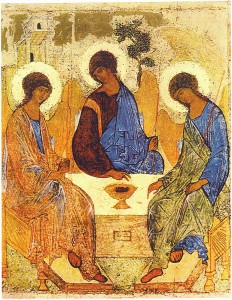
The season of Lent reveals truth as paradox: on the one hand, the weakness of our wills and the limits of our abilities to do what God requires; and on the other hand, the depth of God’s love for us in Jesus and the boundless ability of the Holy Spirit to transform our lives.  Contemplating this paradox is the journey of Lent.6 OT Trinity Rublev

To help us do this, we’ll see a new artful expression appear, by degrees, on the East wall of our sanctuary during this season.  This installation is inspired by 15th century Russian iconographer Andrei Rublev’s depiction of the Holy Trinity. (At right)

Franciscan Richard Rohr notes that icons like this “point beyond themselves, inviting a sense of both the beyond and the communion that exists in our midst. This icon shows the Holy One in the form of Three, eating and drinking, in infinite hospitality and utter enjoyment between themselves. The gaze between the Three shows the deep respect between them as they all share from a common bowl.”


IMG_0172The opening stanza of Brian Wren’s hymn on the Trinity reads:


When minds and bodies meet as one and find their true affinity,

we join the dance in God begun and move within the Trinity,

so praise the good that’s seen and done in loving, giving unity,

revealing God, forever One, whose nature is Community.[1]

The central truth the season of Lent reveals is the incessant Voice of the Triune God calling us into relationship—through the Ten Commands; through Jesus’ journey to the cross; through the Font which gave us birth; through the communion of the Table. All of these reveal the passionate longing of the Triune God to share the Divine Feast with us—to teach us the steps of the sacred Dance.  This truth is more hopeful than anything the world casts our way.  So get your toes a tapping!

With you on the Way,

Pastor Erik

[1] Brian Wren. Words © 1980, Hope Publishing Company 

Give me your tired, your poorEmma Lazarus

your huddled masses yearning to breathe free;

the wretched refuse of your teeming shore;

send these—the homeless, tempest-tossed to me;

I lift my lamp beside the golden door!

The New Colossus, by Emma Lazarus

On the pedestal of the Statue of Liberty in New York Harbor


Beloved of God,

Many of us can remember a time in elementary school when we were assigned the task of committing a song or poem to memory.  The “50 Nifty States Song” I learned as a 4th grader at Hawthorne Elementary in Albert Lea, Minne­sota, was one of these.  I can still recall the school assembly when all of us fourth graders sang out the name of each state—in alphabetical order no less.  The song had a catchy tune, and even now as I write that tune plays in my head some 50 years later!  Things put to memory when we’re young tend to stick.  Which is another argument for committing Bible verses and hymns to memory—they’ll be accessible to us when we need them.  But that’s another topic.

Along with the “50 Nifty States Song” there is a poem I committed to memory as a youngster that has stayed with me all these years.  It’s a poem by Emma Lazarus (above).  She donated the poem in 1883 to the campaign to raise funds for the Statue of Liberty’s pedestal. It came to prominence only after her death when it was placed on the completed pedestal in 1903.  I saw it in person when our family visited Liberty Island at the end of my sabbatical in 2014.  Ms. Laza­rus entitled her poem THE NEW COLOSSUS. Having seen the place in Rome where Nero’s original COLOSSUS once stood, I had another layer of meaning to add to the content of what she wrote.

As our boat prepared to land on Liberty Island that brilliant summer day, the words which I’d put to memory in my elementary school choir came to the surface once more.  The poem, which never fails to move me, took on even greater meaning when we docked at Ellis Island.  There we stood in the very room where my grandparents Ingvald and Anna Kindem had stood with their three young children, Olaf, Halvor and Andi, on June 5, 1923, as immigrants from Norway.  In the computerized files, we were able to find their names on their ship’s manifest and even glimpse a photo of the ship itself—The Stavangerfjord—which bore them safely across the ocean to this new land.

Emma Lazarus’ poem and my own family’s immigration story have been much on my mind in the aftermath of the recent Executive Order banning the admittance of immigrants and refugees from certain countries.  Had Ingvald and Anna been turned away at Ellis Island, what would our family story have been?  We talked about that around the dinner table last night.  Our kids figured that if this had happened, they’d have been born in Norway.  “Not so fast,” Chris countered.  “If Great grandpa Ingvald and Great grandma Anna had been turned away, Grandpa Roald and Grandma Shirley would never have met; Dad (Erik) would not have been born, he and I would not have married, and therefore you two would never have been born.”  A point worth contemplating.

The President’s Executive Order is already having a direct impact on the Lutheran Church’s work with refugees, as David Duea, President and CEO of Lutheran Community Services Northwest pointed out in an email this week:

“Our Unaccompanied Refugee Minor program (URM) in Spokane was ready to welcome a 17-year-old young man, scheduled to arrive early this week. He is from Afghanistan, where his parents and sister were killed by a landmine. The boy fled Afghanistan to Indonesia, where he has been living in a shelter. He was scheduled to fly from Jakarta to Los Angeles Monday. Unaccompanied refugee minors usually fly with an escort.  We have not heard from the escort… We have no idea what to expect. This is one example of how a story being felt around the world is impacting real, individual lives.”

Another stark example concerns a 24-year-old man from Sudan who has been registered and waiting to come to the U.S. since 2010.  Mary Flynn, Refugee Program Director at Lutheran Social Services of Milwaukee, Wisconsin, is worried the Sudanese refugee is in danger. His case was being expedited because he was a victim of violence and torture.  Now after 7 years of waiting, the possibility of resettlement itself seems in danger.

It has been heartening to see the many expressions of concern and solidarity, and offers of legal aid for those whose lives have been flung into turmoil as a result of the Order.   As followers of Jesus—who was himself a refugee from violence (Mt. 2:13-18)—you and I are called to stand with the vulnerable, whom Jesus called “the least of these who are members of my family.” (Mt. 25: 40)

Some of you remember the chaos that swept through Japanese immigrant communities 72 years ago this month as a result of Executive Order 9066.  The displacement and internment of people of Japanese ancestry—including many who were citizens of the United States—was driven by prejudice and fear.  It remains a dark chapter in our nation’s history.

It seems to me that the words emblazoned on the Pritchard Park Memorial on Bainbridge Island—Nidoto Nai Yoni–“Let it not happen again”— also apply to the immigrant and refugee crisis that is developing before our eyes right now.  A clear process for vetting refugees has been in place for decades and often takes years to complete.  Less than ½ of 1% of the world’s refugees will ever have the opportunity to be resettled in the United States.  When it comes to refugees, there is no such thing as a “rush to our borders.”

We join our colleagues at Lutheran Community Services Northwest and at Lutheran Immigration and Refugee Services in welcoming refugees no matter what their religious background or country of origin may be. We support refugees who are fleeing dangerous and violent conditions.  Not only is our compassion needed, it is com­manded by our Lord. Faith is more verb than noun—it has legs.  Let’s seize the day by putting our legs of faith to work for the sake of refugees and immigrants.  Let’s make certain Lady Liberty’s lamp continues to shine by the golden door.  In the process, we will ourselves become the “light of the world” Jesus has called us to be.

With you on the way,

Pastor Erik


January 30, 2017

Blessed are the merciful, for they will receive mercy. Yesterday, we heard these words in the Gospel reading from Matthew 5:1-12, the beginning of Jesus’ Sermon on the Mount. In the Beatitudes, Jesus lays out a vision for life in God’s realm, characterized by seeing those who are often most disregarded, including the meek, the mourning and the peacemaker, as bearers of God’s blessing. Over the coming weeks, we will continue to hear this Gospel, including Jesus’ call for his disciples to be carriers of God’s light and hope and reconciliation to a world deeply in need of them.

In this spirit, earlier last week I communicated with the Trump administration asking that it not stop the U.S. refugee admissions program or stop resettlement from any country for any period of time. The Bible calls us to welcome the stranger and treat the sojourner as we would our own citizens. I agree with the importance of keeping our country secure as the administration stated in its executive order last Friday, but I am convinced that temporarily banning vulnerable refugees will not enhance our safety nor does it reflect our values as Christians. Instead, it will cause immediate harm by separating families, disrupting lives, and denying safety and hope to brothers and sisters who are already suffering.

Refugees being resettled in the United States have fled persecution because of their race, religion, nationality, political views and/or associations. They wait for years for the chance to go home. But sometimes, there is no home for them to go back to. We know from our partners at Lutheran Immigration and Refugee Service (LIRS) that only 1 percent of all refugees are chosen for resettlement.

People of faith helped start and still sustain the refugee resettlement program in the United States following World War II. As Lutherans, many of our ancestors faced the pain of having to flee their homes and the joy of being welcomed in new communities across the United States. As we have done throughout history, millions of Lutherans across the country honor our shared biblical values as well as the best of our nation’s traditions by offering refuge to those most in need. We are committed to continuing ministries of welcome that support and build communities around the country and stand firmly against any policies that result in scaling back the refugee resettlement program.

We must offer safety to people fleeing religious persecution regardless of their faith tradition. Christians and other religious minorities suffer persecution and rightly deserve protection, but including additional criteria based on religion could have discriminatory effects that would go against our nation’s fundamental values related to freedom of religion. 

I invite ELCA congregations into learning, prayer and action on behalf of those who seek refuge on our shores. The ELCA “Social Message on Immigration,” AMMPARO strategy and LIRS resources are good places to start. Those who have been part of resettling refugees or have their own immigration experience have important stories to share with their communities and testimony to make. I also encourage you to consider adding your voice by calling your members of Congress to share your support for refugees and using online advocacy opportunities through current alerts at ELCA Advocacy and LIRS.

In Matthew 25:35, Jesus said, “I was a stranger and you welcomed me.” Our Lord not only commanded us to welcome the stranger, Jesus made it clear that when we welcome the stranger into our homes and our hearts – we welcome him.

God’s peace,

ElizabethEatonSignature0715

The Rev. Elizabeth A. Eaton
Presiding Bishop


 “The voice of the LORD is upon the waters;

the God of glory thunders;

the LORD is upon the mighty waters.”

– Psalm 29:3

Beloved of God,

Chilly weather companions our passage from 2016 to 2017.  Mini-snow people have spouted on our back lawn, and Kai and Naomi, inspired by the properties of snow and ice, have been on expeditions harvesting sheets of ice from neighborhood puddles and bearing them home, like treasure, on their sled.  Watching them brings me back to the days when I did same—with icicles—during long Montana and Minnesota winters.  The bigger, the better!

Watching the snow accumulate on the Olympics and Cascades evokes sighs of gratitude within me.  In this age of climate breakdown (climate “change” is too benign a term), heavy mountain snows recall the way it’s meant to be.  A heavy snowpack plays an essential role within the annual water cycle, and translates into promising prospects for everything and everyone who calls the Northwest bioregion home.  Yet, it hasn’t always been that way, as Cynthia Barnett documents in her book, RAIN: A Natural and Cultural History.[1]

“As even tempered as it grew up to be,” she writes, “Earth started off 4.6 billion years ago as a red-faced and hellish infant…For its first ½ billion years, Earth was a molten inferno some 8,000 degrees Celsius—hotter than today’s Sun.”  Scientists aptly name this violent period in Earth’s evolution “the Hadean eon,” from the Greek word Hades, or hell.

But the same process that made Earth a molten mass also set the stage for what it would some day be.  The flaming meteors that bombarded Earth had water locked inside of them, and as they crashed and split apart, they spewed out that water in the form of vapor.  “All that water,” Barnett writes, “would prove an invisible redeemer [when]… about a half a billion years after it started, the blitzkrieg began to wind down.  As the last of the flaming chunks fell to the surface or hurtled away, the planet finally had a chance to cool.  The water vapor could condense.  At long last, it began to rain.”

We’re not talking Seattle drizzle, Midwest gully washers, or even Florida hurricanes, folks—we’re talking cataclysmic torrents that fell and were taken up again and again and again in a seemingly endless cycle; storms that went on, literally, for millions and millions of years, eventually forming the primordial oceans, aquifers, lakes, and rivers from which life itself first emerged.  Rain: the wellspring of life.  Rain: the force which has shaped the story of life on this planet, and human culture in particular, from the beginning.  Rain: which seeded whole civilizations and led to their undoing.  Rain and its wondrous offspring—clouds and rainbows—which have inspired painters, writers, and poets for thousands of years.

Seeking language to describe the ideal king, the psalmist writes: “May he be like rain that falls on the mown grass, like showers that water the earth.” (Ps 72:6)  And David’s hymn of praise, Psalm 68, extols the God who “rides upon the clouds”; the “Father of orphans and protector of widows” who sends rain in abundance, restoring the heritage of his chosen ones; the “Rider in the ancient heavens” whose “power is in the skies.”

Sacred traditions with water at their centers can be found among peoples all over the world, including our own.  In the Western church, the first Sunday after the Epiphany is celebrated as The Baptism of Our Lord, and the appointed gospel takes us to the waters of the Jordan, where people have traveled in schools to receive John’s baptism of turning.  When Jesus comes to be baptized, John is taken aback at first and suggests their roles ought to be reversed.  But after receiving reassurance from Jesus, John immerses him in Jordan’s waters.  Then—the Spirit of God like a dove, and the Voice from on high: THIS IS MY SON, THE BELOVED, WITH WHOM I AM WELL PLEASED. (Matt. 3:13-17) Ever since this encounter, baptism has been the headwaters of the Christian story, a sacred sign that we our bound to God, that we journey with Christ, and like him are companioned by the Holy Spirit.

From that moment countless eons ago when Earth’s molten surface began to cool, and the heavy vapors of H2O that surrounded her young atmosphere began to condense, giving birth to rain, the One who called it all into being has been waiting, patiently, for the opportunity to call you to new life through these waters.   Never doubt for one moment that you were meant to belong—to be bound as, St. Patrick sang, “to the strong name of the Trinity, the Three in One and One in Three.” And when you see the snow pilling up in the mountains; when you watch the raingardens at Peace receive the sky’s liquid offering; when you collect ice offerings, muddle in puddles, cross creeks and rivers, and venture on, over, or around the Salish Sea, remember that these waters, which once fell as rain and will again, are all signs—constant and true—of God embracing and blessing you.

Walking wet with you,

Pastor Erik


[1] Cynthia Barnett. Rain. A natural and cultural history. (New York: Broadway Books, 2015)

“If you continue in my word, you are truly my disciples;

and you will know the truth, and the truth will make you free.”

John 8:31-32

Beloved of God,

One of the events that informs our life together and the life of the larger church this year and next is the 500th Anniversary of the Reformation on October 31, 2017.  In anticipation of that event, the Sunday Adult Class is beginning the fall with a study of Martin Luther’s 95 Theses.  It was these Theses, posted on the door of the Castle Church in Wittenberg, Germany on October 31, 1517, that historians point to as the beginning of what would come to be called The Reformation.  Luther wasn’t the only reformer, of course.  Many others, both prior to, during, and after Luther, paved the way for this new movement within the church catholic to take root.  But Luther became the face of the Reformation.  His penchant for prolific writing (55 volumes worth!) in language the common person could understand, combined with the invention of a printing press with movable type, made him the bestselling author in Europe for over a decade.  What he wrote—much of it challenging to greater or lesser degree the received tradition he had inherited—caught the attention of the age.  But what was it that made this movement which began as a trickle, become a flood?  What were the “hidden springs of imagination, high up in the hills, that were to feed the broad river of the Reformation?”[1]  According to author Peter Matheson, it was the advent of new images, allegories and metaphors for the divine and the human—metaphors taken from a reanimated reading of the Bible—that subverted the world which the Reformers inherited and paved the way for another. “When your metaphors change,” writes Matheson, “your world changes with them.”

The most pervasive image of the Reformation is that of the liberated Word of God.  The gospel of John is steeped in image and metaphor, as evidenced by the series of seven “I AM” statements of Jesus: “I am the bread of life; I am the light of the world; I am the gate for the sheep; I am the good shepherd; I am the resurrection and the life; I am the way, the truth, and the life; I am the vine.” In John 8:31-36, the gospel text appointed for Reformation Sunday, Jesus says to the people who had believed in him, “If you continue in my word, you are truly my disciples; and you will know the truth, and the truth will make you free.” Their first answer (and mine) is “We have never been slaves to anyone.” Oh how hard we work to keep the truth of our shadow from becoming known!  We do our best to hide it even from our own selves!  But before we can participate in the freedom God offers us in Jesus, we must own the fact that we are far from free; there are forces at work within and around us that keep us bound tight.  The freedom from “sin, death, and the devil” that Luther understood as pure gift of God—unmerited and unachievable—compelled him to preach Word alone, Faith alone, Grace alone, as the pillars of the good news.  This insight has served as a touchstone for the whole church for five centuries.

The danger inherent in any historical movement is that overtime the images and metaphors that once served as a fresh, invigorating wind, awakening the senses and animating the imaginations of a generation, can become immovable truths, fixed in stone; can become, in other words, fossilized.  The invitation for us, as we enter this 500th anniversary year, is not only to ask what images animated Brother Martin and other 16th century Reformers, but what images and metaphors can animate the church of this day, carrying the momentum forward so that the church does not become a museum relic of the past.

The life we share together is full of possibilities—you can read about many of them in this edition of Peace Notes.  Which ministry opportunities ignite your passion? Which are you drawn to be part of?  Where are the gaps that you sense need to be filled?  Go ahead!—use your imagination and creativity to ask how you individually might embody good news in our time and context, and how we might do so together.

With you on the Way,

Pastor Erik


[1] Peter Matheson, The Imaginative World of the Reformation. (Minneapolis: Fortress Press, 2001).

Pastor’s Pen for September 2016

Comments Off on Pastor’s Pen for September 2016

Have you not known? Have you not heard? 

The Lord is the everlasting God, the Creator of the ends of the earth; who does not faint or grow weary;

whose understanding is unsearchable. God gives power to the faint, and strengthens the powerless.

Even youths will faint and be weary, and the young will fall exhausted;

but those who wait for the Lord shall renew their strength, they shall mount up with wings like eagles,

they shall run and not be weary, they shall walk and not faint.

– Isaiah 40:28-31

Beloved of God,

Our approach to Rachel Lake, in the Alpine Lakes Wilderness, was four miles long.  The first three followed Box Canyon Creek up valley, gradually gaining elevation from 2,800 feet at the trailhead to 3,400 at mile three—an average gain of only 200 feet per mile.  But the final mile—up the steep wall that gave Box Creek its name—had acquired a nickname of its own: the Cruel Mile.  As Kai and I began the upward slog, using our poles and any available tree, rock, or root we could grab, we became newly aware of the weight of our packs, and the reality of the 1,300 ft elevation gain ahead of us impressed itself viscerally on our minds and bodies.  This was Kai’s first backpack trip, and I’d put a good deal of effort into finding a destination that would allow him to experience the gifts the wilderness provides without exacting too steep of a price.  As my legs grew tired, I found myself inspired by Kai’s desire to keep going without complaint. “How much do you think we have left, Dad?” became Kai’s refrain every few minutes. “Oh,” I would reply, remembering our sabbatical experience, “about 200 meters.”[1] By the time we arrived at Rachel Lake we were eager to shed our gear and make camp.  By the time the sun set that evening, we were more than ready to crawl into our bags and give our bodies a rest.

When morning came, the weariness of the day before had dissipated, and after a breakfast of freeze dried eggs and sausage, our thoughts turned to the day ahead.  Another mile, and 400 feet above us, lay the Rampart Lakes, a series of smaller alpine lakes heartily endorsed by the guide book, and we set our sights there.  And Rampart Lakes did not disappoint!  But it was still early afternoon and there was plenty of day left.  What if we were to climb to the top of that saddle over there, at the south end of the basin?  And so we went.  The final 40 feet required some scrambling, but in the end we were rewarded with vistas of mountains all around, and a view all the way down to our Rachel Lake campsite far below.  Unforgettable.

Meaningful experiences, shared vistas, shape us.  They become reference points in our life together.  Sometimes, the experiences we worked hardest to obtain become the most precious to us. Not all shared experiences, of course, are worthy of being remembered.  Each of us could point to decisions, conversations, encounters, mistakes that we would gladly do over or take back if we could.  Regret, whatever its specific content, can ride roughshod over us if we let it, even to the point of overwhelming the rich and joyful moments we’ve known.  Thank goodness we have as companion on the way a God who knows how to strengthen us when we’re weak and to lift us when we’re weary—whether that weariness comes from physical exertion or from the weight of past sins!

As summer turns to fall and rhythms shift and change, we can take a cue from the autumn leaves, which teach us the art of letting go.  We have much to engage in together this month in our shared ministry at Peace; so many meaningful activities and opportunities for learning and serving and growing.  At times the calendar can become so cluttered that it feels less like a gift and more like an uphill slog!   But our Lord’s gracious accompaniment makes the journey all worthwhile.  With a spirit of joy and comradery—let the fall begin!

With you on the Way,

Pastor Erik


[1] Wherever we went on foot in Italy during our sabbatical, whether in the cities or on rural roads or trails, when we stopped to ask a local person how far we had to go to reach a particular destination, the answer was, inevitably, “About 200 meters.” This was true whether the actual distance was half that amount or several times that amount.  It became an inside family joke.